Memory is a continuing decision
An AI assistant that recalls an earlier conversation creates an expectation about continuity. In my view, the corresponding product decision should be equally explicit: what is being retained, for which purpose, and who can change that decision? A vague promise that the assistant remembers useful context leaves those questions open. Retaining everything and deleting everything are both choices with consequences. The useful discussion is about the specific information needed for a continuing task, the people affected by it and the evidence available when that information is reused.
This is an opinion about retention design, not a statement of a universal legal period or an implemented GPIRL feature. The ADK documentation describes memory services for retrieving information across conversations, including in-memory and provider-backed examples. It also distinguishes extracted memories from transcript-oriented retrieval. Those documented options illustrate why the word memory cannot specify a complete retention policy by itself. The backend, SDK version and application behavior still need to be examined. A capability to retrieve something is not evidence that keeping it indefinitely is appropriate. [S1]
Define the information before the clock
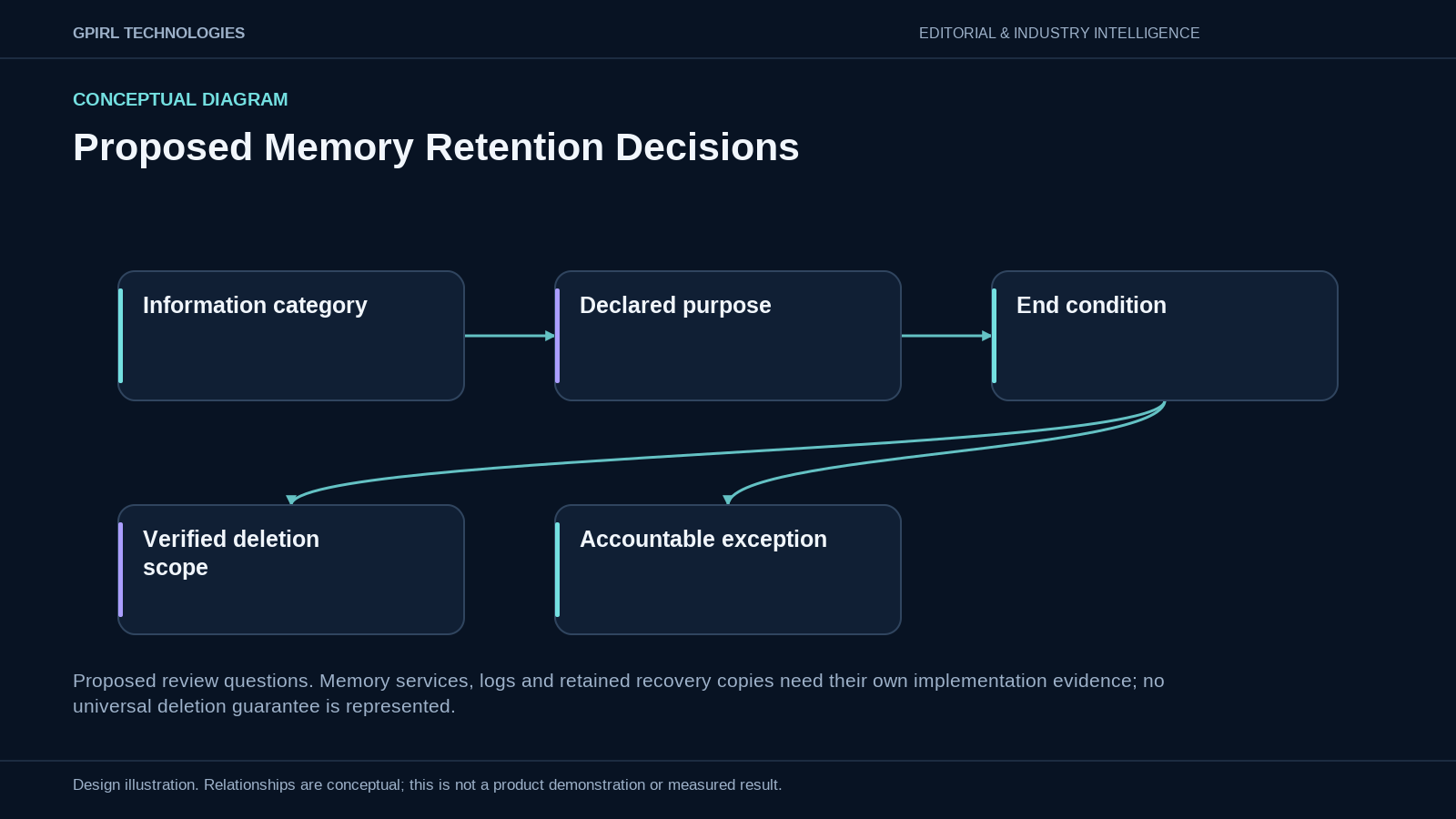
I would start a retention discussion by distinguishing the live conversation, any selected information carried forward, operational logs and retained copies used for recovery. These are proposed review categories, not a claim that every application contains the same stores. Each category can have a different purpose and a different owner. A user-facing sentence about forgetting a conversation should identify which categories it covers. Otherwise, a team could believe that a visible deletion control answers a broader question than its actual implementation supports.
A policy also needs to distinguish a direct user statement from a system inference about that statement. Consider a hypothetical assistant that records a preferred delivery location and separately infers a preferred working pattern. The inference should not silently acquire the same standing as an instruction. I would ask whether the record preserves that difference, whether it can be challenged and whether the preference remains appropriate for the next task. This is a conceptual example, with no claim about an operating product, an observed user or a measured privacy outcome.
Choose an end condition that can be explained
A retention period is easier to defend when it is linked to a named purpose. My proposed design review would ask what event ends that purpose: completion of a task, an explicit user decision, a change of responsibility or another defined condition. A duration may still be useful, but a bare number does not explain why the information remains relevant. The decision should state who selected the condition and how exceptions would be reviewed. This article supplies no universal duration, jurisdictional deadline or legal conclusion.
NIST describes its Privacy Framework as a voluntary tool for identifying and managing privacy risk. The portal's version and draft labels matter; a draft should not be presented as a final standard. That framework offers context for considering the consequences of processing information, rather than an answer to an application's exact retention period. My recommendation is to record the rationale alongside the chosen condition, including the interests that may conflict. A business preference for continuity and a person's preference for forgetting should be visible as distinct inputs to a decision. [S2]
Make deletion claims match the implementation
The strongest deletion statement an interface can make is the one its implementation evidence supports. I would separate stopping future retrieval, removing an item from an active memory store, dealing with derived summaries and handling retained recovery copies. Those are questions to investigate, not claims that a particular provider implements deletion in a particular way. If a team has checked only an active store, it should not describe the result as disappearance from every possible copy. Unknown propagation should remain an explicit limitation until it has been investigated.
There is also a difference between requesting a change and confirming its effect. A proposed product flow could acknowledge the request, explain the scope being processed and report what was actually verified. That flow would need its own implementation and tests before anyone could promise it. A review should examine what happens when a backend is unavailable, an identifier cannot be resolved or a derived record lacks a reliable link. None of those cases should be converted into a successful deletion message merely to make the interface feel complete.
Retrieval should preserve the reason for remembering
A memory can be correctly stored yet poorly used. In my proposed review, the retrieval decision would ask why this item is relevant to the current task and whether its original context still applies. The ADK distinction between extracted memory and transcript-oriented retrieval is useful background, but it does not establish that either approach always preserves the interpretation a person intended. I would make the source and status of a recalled item available for review where they materially affect a decision. That is a design recommendation, not an SDK guarantee. [S1]
A hypothetical change of role illustrates the issue without requiring invented performance data. Information supplied while someone coordinated a project may no longer be appropriate after responsibility moves elsewhere. Simply finding the earlier record does not settle whether it should guide the next answer. I would ask who can update the retained information, how disagreement is represented and whether an unresolved dispute should limit its use. These questions concern the continuing meaning of a record rather than the accuracy of a search result alone.
Review the policy through observable cases
A retention policy becomes reviewable when it can be connected to expected behavior. I would use proposed cases covering an ordinary expiry condition, a user correction, a deletion request and a recovery from an older retained copy. The cases should identify what evidence would support the expected outcome and which parts cannot yet be checked. They are not a report of completed tests. A successful request response would be evidence about that response, while confirming the resulting storage and retrieval behavior would require additional observations.
The review should also name the person responsible for an exception. If information must be held beyond the ordinary condition, the exception needs a purpose, an accountable decision and a way to revisit it. I would avoid converting this into a permanent exemption merely because the data may someday be useful. Likewise, an unresolved backend question should have an owner and a clearly described effect on the product's claims. Honest incompleteness is more actionable than a broad assurance unsupported by an inventory of the relevant stores.
Publish a promise that can survive a difficult question
The policy I would want to read explains the information retained, the purpose, the end condition and the scope of deletion in language a person can connect to their own use. It also identifies the limits of that explanation. A statement about an active memory service should not imply a conclusion about logs or backups that were never reviewed. Separate, understandable claims give both users and operators a way to challenge an assumption without needing to reverse-engineer the application's internal vocabulary.
An explicit policy does not by itself establish privacy compliance or appropriate retention. It makes the decision visible enough to examine. My view is that this visibility belongs alongside the feature, rather than being deferred until a dispute exposes an unexamined copy or inference. The practical goal is a consistent relationship between what the assistant recalls, what the organization can substantiate and what the person was told. That relationship still needs implementation evidence, ongoing responsibility and a willingness to revise a promise when its limits become clear.
Official background videos
External publisher context. These recordings do not demonstrate GPIRL products or validate the proposed designs.
- National Institute of Standards and Technology — The NIST Privacy Framework
Privacy-risk framing for retention purpose, accountability and user-facing promises; not a legal deadline or deletion guarantee.
Sources and further reading
References do not imply product certification or endorsement.
Have a related operational question? Bring this question to a GPIRL Technologies discovery discussion.