Delegation begins with separate questions
An agent that can invoke an enterprise tool creates several authorization questions. Which client is requesting access, which grant is being used, which resource will accept the resulting token and which operation is permitted there? Treating those questions as a single decision can make a valid credential appear to authorize more than the resource owner intended. This Explainer separates the relevant OAuth guidance from proposed implementation choices. It does not describe a deployed GPIRL connector, supply a complete identity architecture or claim that OAuth prevents every misuse of a tool.
RFC9700 is the OAuth2.0 Security Best Current Practice, published in January2025. Its normative language matters. Public clients must use PKCE against authorization-code injection and misuse; PKCE is recommended for confidential clients, with specified alternatives and conditions. The implicit-grant guidance uses a conditional recommendation against that flow, while the resource-owner password credentials grant must not be used. These are distinct statements, not one universal instruction to apply every control identically to every client. The actual client and flow must be identified before applying them. [S1]
Keep the grant separate from the business instruction
For a proposed agent integration, I would document the relationship between the user's instruction and the authorization grant without assuming that they are equivalent. A person may ask for a report while the connected application possesses credentials that could support additional operations. The existence of those credentials does not settle which operation the application should attempt for that instruction. The resource's actual authorization checks and the application's task interpretation need separate review. This is a design distinction, not an assertion that an OAuth token encodes every business approval condition.
A hypothetical document tool illustrates the issue. Imagine a read-oriented task in an environment where the connected application also has a separately configured ability to modify records. The review question is whether the proposed design keeps those capabilities distinguishable and whether the resource rejects an operation outside the applicable authority. No request is executed in this example, and no token value or provider configuration is supplied. The conceptual case shows what evidence to seek; it does not prove that a chosen scope name enforces the desired boundary.
Read scope and privilege controls in context
RFC9700 discusses access-token privilege restriction, sender-constrained tokens and refresh-token controls with different scope and normative wording. Those controls should not be flattened into a claim that using OAuth automatically implements least privilege or prevents lateral movement. PKCE concerns the authorization-code exchange; it is not the entire delegated-agent authorization design. A review needs to connect the applicable guidance to the actual client, authorization server and resource behavior, including any relevant conditions. A protocol recommendation cannot substitute for evidence about a deployment's configuration. [S1]
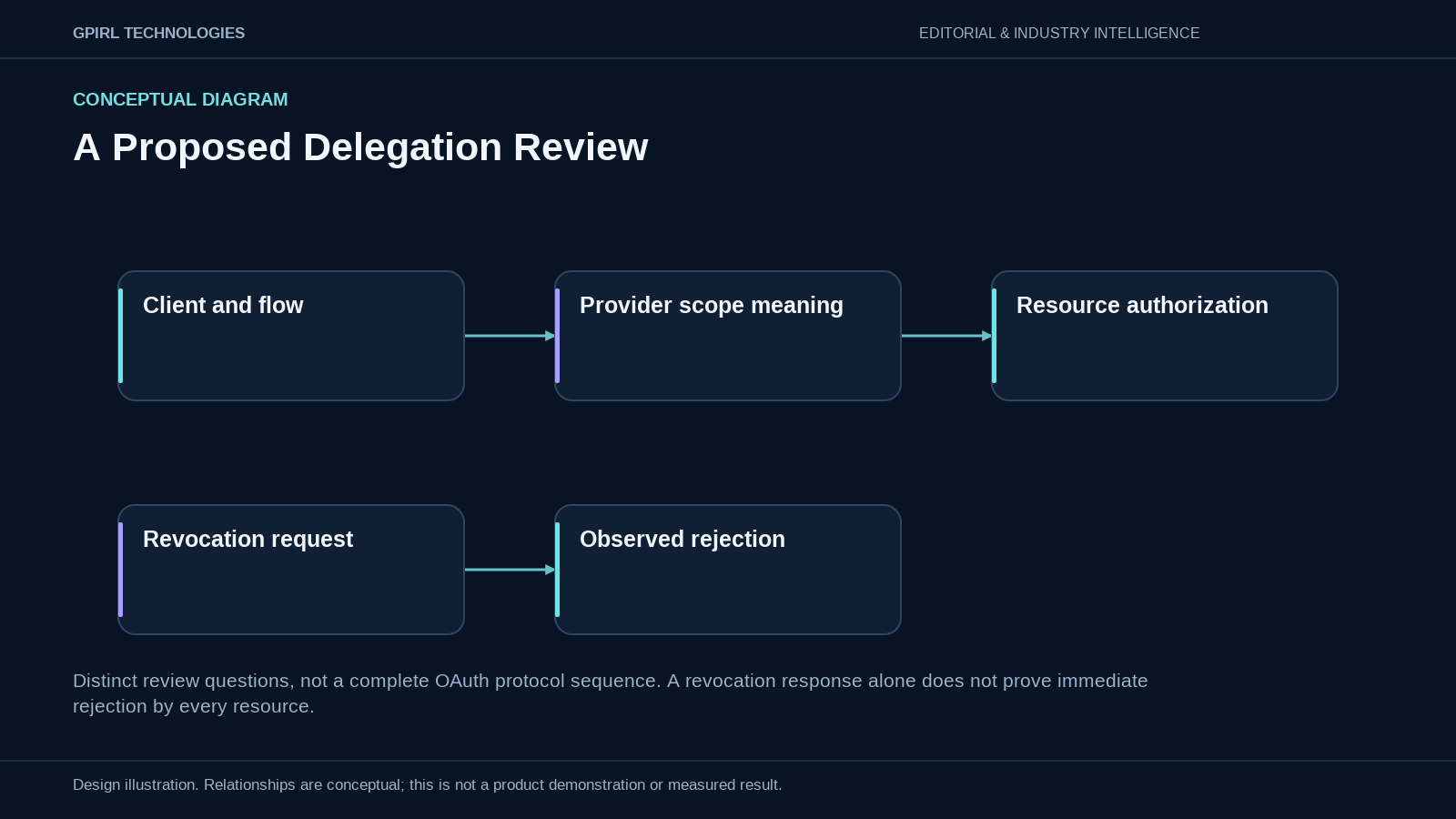
In the proposed document-tool review, I would ask what the requested scopes mean to the particular provider and what the resource actually permits when presented with the resulting credential. A label that sounds read-only should be checked against provider documentation and observed behavior before being described that way publicly. The design should also state what remains outside that check, such as an application's later interpretation of returned content. Restricting a credential and judging the appropriateness of an agent's next action are related review tasks, with different evidence.
Revocation is an operation with a defined scope
RFC7009 specifies token revocation involving refresh tokens and access tokens, with related tokens based on the same authorization grant affected where applicable. Its requirements distinguish token-type support and implementation considerations. An invalid-token request can receive a successful revocation response, so that response alone does not demonstrate that a particular previously usable token was found and disabled. The endpoint's response needs to be interpreted according to the specification and the deployment rather than as a universal inventory report of every credential belonging to a user. [S2]
The proposed integration review would therefore identify which token is the subject of a revocation request and what the provider says about related credentials. It should avoid inferring a universal user-wide or client-wide logout from a provider-specific example. A fictional user decision to disconnect a tool could require several product behaviors, but the exact sequence must be established for the chosen provider. A UI message such as connection removed should describe the evidence available, including any known limit on existing credentials, rather than quietly expand an endpoint result into a broader promise.
Distinguish the request from downstream rejection
A revocation call does not by itself establish immediate rejection by every resource that might accept a credential. RFC7009 includes implementation considerations relevant to the relationship between token validity and the resource's knowledge of revocation. A deployment review must examine its actual propagation, validation and token-lifetime behavior before stating a rejection guarantee. This article does not select a universal propagation interval or claim that every authorization server and resource pair behaves identically. An unanswered deployment question should remain a stated gap. [S2]
For a proposed test plan, I would separate observing the revocation response from observing a later attempt to use the relevant credential at a specified resource. Both observations would need the correct credential, environment and interpretation. A test against one endpoint would support a conclusion about that observation, not every resource or every future configuration. The plan is unexecuted here. No access attempt, successful block or elapsed propagation time is reported, and the example is not an instruction to test credentials against a system without the appropriate authorization.
Make the integration review reproducible
The proposed review record should identify the client category, grant or flow, authorization server, resource, documented scope meanings and applicable specification sections. It should distinguish a configuration statement from an observed result and record the versions or dates needed to interpret either. If confidential-client behavior is being assessed, that fact should be explicit rather than assumed from a web interface. The purpose of this record is to make a conclusion inspectable, not to imply that filling every field creates a secure system.
A useful exception is a provider behavior that cannot yet be verified. The reviewer could narrow the public claim, request more evidence or prevent the integration from being used for a task whose requirements depend on the missing behavior. Those are proposed governance choices. They should state who is responsible and what evidence would change the decision. An unresolved scope or revocation question should not disappear because another part of the OAuth flow passed a check, just as a functioning login should not be treated as a full authorization assessment.
Describe the boundary the evidence supports
For an agent tool, the most useful explanation connects a specific delegation arrangement to a specific permitted use. It says what was requested, what the provider documents, what the resource was observed to enforce and what remains untested. This avoids turning protocol terminology into an assurance about the entire workflow. The application's interpretation, data handling and subsequent actions may require additional assessment even when the relevant token operation follows the applicable specification. No single protocol check establishes every property of that larger system.
The practical outcome of this Explainer is a set of distinctions to preserve: code-exchange protection, credential privilege, business intent, token revocation and resource rejection. They belong in the same integration conversation while retaining their different meanings. The standards provide precise starting points; an implementation supplies the evidence for any stronger claim. Until those observations exist, the proposed review should report its assumptions and gaps without inventing provider semantics, claiming completed tests or suggesting that a GPIRL product already implements the design.
Official background videos
External publisher context. These recordings do not demonstrate GPIRL products or validate the proposed designs.
- National Institute of Standards and Technology — The NIST Cybersecurity Framework (CSF) 2.0
General cybersecurity-control context; OAuth client, scope and revocation facts are supported by the cited RFCs, not this video.
Sources and further reading
References do not imply product certification or endorsement.
Have a related operational question? Bring this question to a GPIRL Technologies discovery discussion.