The Risks of Automatic Model Promotion
Suppose a release system has an incumbent model and a candidate that passed the team's selected offline checks. The next question is how much production exposure, if any, would provide useful further evidence. This is a hypothetical release decision rather than a claim about industry adoption. The position developed in this Opinion is that a model change deserves an explicit acceptance and recovery policy. The policy may be automated, but its scope should be understood before the candidate is allowed to affect the chosen workflow.
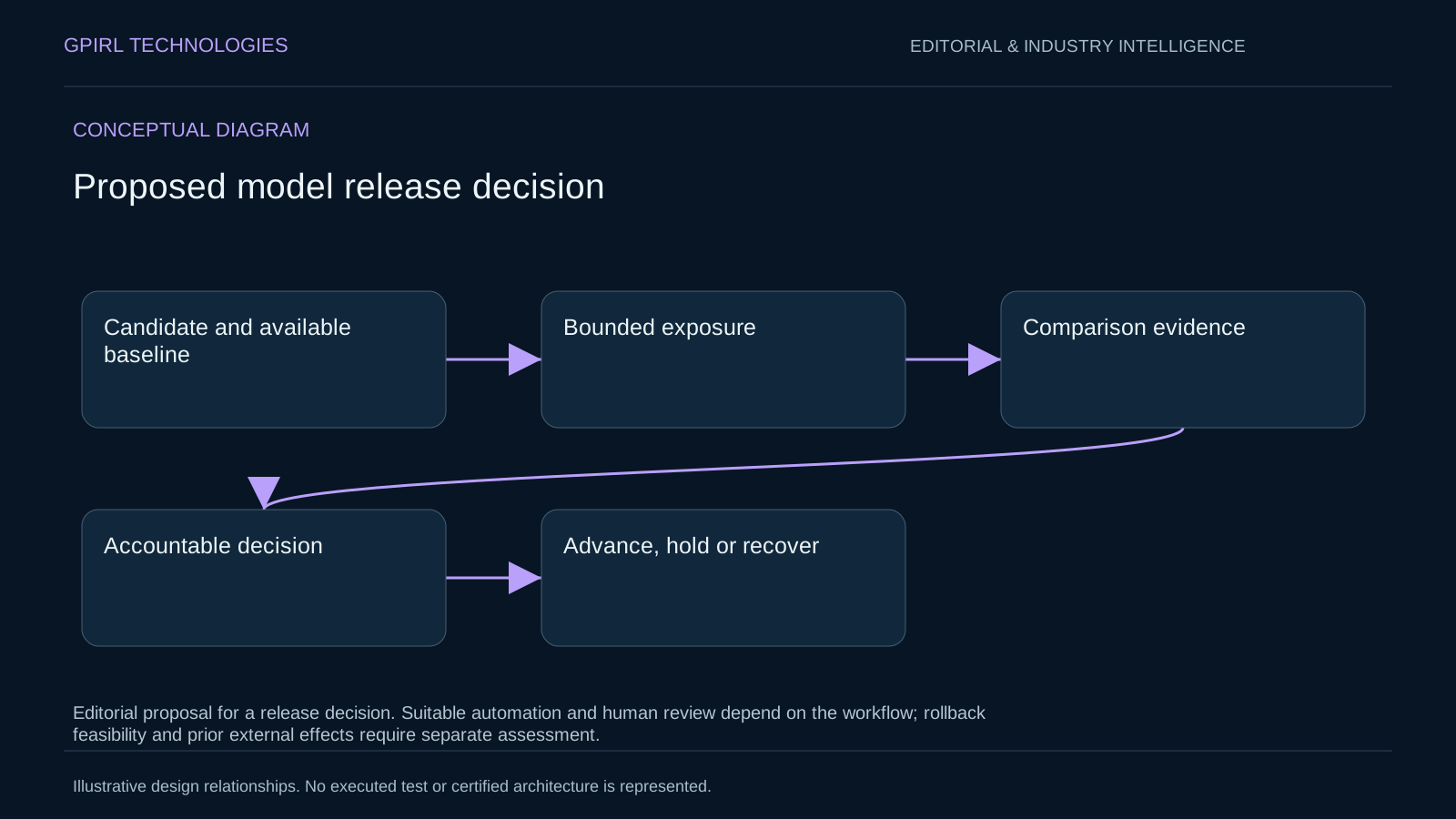
The proposed policy would identify the accountable decision owner, the evidence required to advance and the conditions that cause a hold or recovery action. A canary is one possible source of that evidence. It cannot resolve every safety or business question, and some workflows may not permit the proposed live exposure at all. The point is to make the release decision reviewable, including the uncertainty it leaves behind. This article offers a design argument; it reports no model experiment or operational outcome.
Canarying Principles in Site Reliability Engineering
Google's SRE Workbook defines canarying as partial, time-limited deployment and evaluation of a change against a control [S1]. Limiting exposure can help a team investigate a change before wider rollout, but it does not guarantee that effects remain isolated. Shared state, common dependencies and external actions can connect the populations. In the proposed model policy, those connections would be documented before selecting a canary population. A traffic fraction describes routing exposure, not necessarily the full extent of a possible operational consequence.
For the hypothetical model workflow, the decision owner would choose evidence relevant to the action being changed. That might include service errors, latency, reviewed tool arguments or a specialist assessment of selected outputs. These are candidate measurements, not a universally required checklist. Each chosen signal needs a definition, an owner and an explanation of how it affects the release decision. A technically successful request can still leave a business question unresolved, while an unusual output does not automatically establish a release regression.
Baseline and Candidate Comparison Policies
Google's release engineering chapter describes practices for building, testing and releasing software [S2]. Applying that principle here, our proposed comparison record identifies incumbent and candidate configurations, including relevant prompts, tools and application settings. If several elements change together, the interpretation of a difference becomes harder. The decision owner would record which variables can be held steady. Telemetry and appropriate qualitative review may address different questions; the article does not prescribe the same scoring system for every model release.
The proposed decision rule can automate a hold when an agreed condition is met. Ambiguous evidence should have an explicit escalation path rather than be forced into a passing category. A numerical threshold still depends on its definition, the observed population and the consequence assigned to crossing it. This article does not claim that numbers remove judgment from release governance. It proposes recording the accepted interpretation so that reviewers can distinguish an implemented policy from a threshold selected after seeing the candidate's results.
Traffic Exposure and Time-Limited Rollout
A proposed rollout plan should state the selected exposure and observation period, together with the questions those choices can reasonably address. The SRE Workbook discusses representativeness in relation to population, traffic, duration and metrics [S1]. It does not establish a universal percentage for AI models. A quiet observation window may omit the condition of interest, while a longer window may create additional exposure. The decision owner should document that tradeoff and identify which unrepresented conditions prevent a broader conclusion.
At a proposed checkpoint, the system could advance, remain at the current exposure, reduce exposure or stop the candidate path. The selected action depends on the accepted policy and what is technically feasible. Rerouting is not assumed to be instantaneous or sufficient: queues may contain in-flight work and dependencies may retain state. A recovery test should measure the selected mechanism rather than promise its speed in advance. Exposure controls should be assessed together with the application's handling of effects already produced.
Acceptance Criteria and Qualitative Review
Acceptance criteria should be chosen before the comparison so that the result answers an agreed question. In this article's proposed review, quantitative signals and qualitative judgment have defined roles. A specialist might examine outputs for a particular domain question while an automated rule checks a service limit. The mix depends on the workflow and its consequences. Human review is not prescribed for every output, and an automated policy is not excluded; both need an explicit scope and a clear account of what they establish.
For a chosen action path, the review could examine ordinary and unusual requests that matter to the release decision. This is not a second universal coverage framework or a claim that any sample represents every user. The policy should explain why its selected population and evidence permit the next exposure step. If an important condition is unrepresented, the decision can retain that limitation or require another form of evidence. Clear criteria can make disagreement explicit; they do not remove every ambiguity from the release.
Rollback Triggers and Technical Feasibility
The proposed release policy would define conditions that cause a hold, reduced exposure or a recovery decision. Candidate signals might include an agreed service limit or an unacceptable downstream action proposal, interpreted within their stated scope. The policy should also state who can intervene when the evidence is ambiguous or the normal control is unavailable. This article does not mandate an immediate reroute for every signal. The appropriate response depends on whether the selected baseline and application recovery path are available and suitable.
Rollback feasibility needs its own evidence. An application using a hosted model may not control whether the previous version remains available; an application operating its own model may face different capacity and loading questions. The proposed release record would identify the actual fallback and test the chosen route before relying on it. Reverting future model selection does not undo prior external actions. Recovery of those effects, where possible, requires a separate application procedure rather than an assumption about model version routing.
Managing Uncertainty and Non-Determinism
If outputs can vary under the selected configuration, the comparison should state how repeated observations will be interpreted. This article proposes choosing that approach according to the release question rather than declaring one universally sufficient sample size. A difference may reflect the candidate, a changed workload or another component that moved during the observation period. The review should preserve uncertainty when the available evidence cannot distinguish those explanations. A small number of acceptable examples does not establish behavior for every future request.
Repeated checks can help expose whether the selected observations remain consistent, but they do not guarantee prevention of false alarms. The proposed decision record would preserve the comparison conditions, disagreements and reasons for any exception. If a signal is unavailable, the policy should say whether the missing evidence permits continued exposure. This keeps the release question connected to the actual evidence instead of treating a green dashboard as a complete account of model behavior across all production conditions.
Conclusion on AI Model Release Governance
The value of a canary decision is the scope it makes explicit: what changed, who was exposed, which evidence was considered and why the accepted action followed. Those records can support a later review if an unrepresented case appears. They do not prove long-term stability or certify a model as safe. In this Opinion, the desired result is a decision whose assumptions can be inspected and challenged, together with a recovery path whose feasibility has been examined in the selected environment.
A practical final release record could identify the accepted configuration, exposure period, evidence reviewed, disagreements, decision authority and remaining recovery work. Suitable parts of that policy may be automated. The record should still make it possible to explain why the candidate advanced or why it remained on hold. No process described here guarantees trustworthy behavior for every model output. The editorial proposal is to make the operational decision and its limits explicit before a wider deployment depends on them.
An unexecuted recovery decision exercise
Consider a hypothetical assistant that proposes an administrative update and sends an approved instruction to an external service. A candidate release changes how that instruction is prepared. In a proposed recovery exercise, the team would separate requests still awaiting review, instructions already submitted and confirmed external changes. Returning future requests to the incumbent addresses only the first part of that timeline. For a submitted instruction with an unknown outcome, the application would need to inspect the authoritative service before deciding whether another action is appropriate. This example is not a description of a GPIRL deployment or an executed test.
The exercise would also ask what happens if the incumbent is unavailable when recovery is requested. Depending on the workflow, a possible response might be to stop the affected action path and use the accepted manual process rather than route to an untested replacement. That choice belongs to the workflow owner and needs its own implementation evidence. The release record would state the selected fallback, the authority to invoke it and any work that remains unresolved. No response time or recovery success is claimed here; these are proposed questions for making the release decision concrete.
Official background videos
External publisher context. These recordings do not demonstrate GPIRL products or validate the proposed designs.
- SREcon18 Europe - Canarying Well: Lessons Learned from Canarying Large Populations
Google SRE conference talk on controlled partial releases and canary pitfalls, recorded at SREcon18 Europe in 2018. Release-engineering background; applying those ideas to AI model rollout is editorial analysis. It does not establish AI output safety, universal rollout percentages or reversal of external side effects.
Sources and further reading
References do not imply product certification or endorsement.
Have a related operational question? Use the proposed decision record to review one planned model change.