Anatomy of Apache Iceberg Metadata and Snapshots
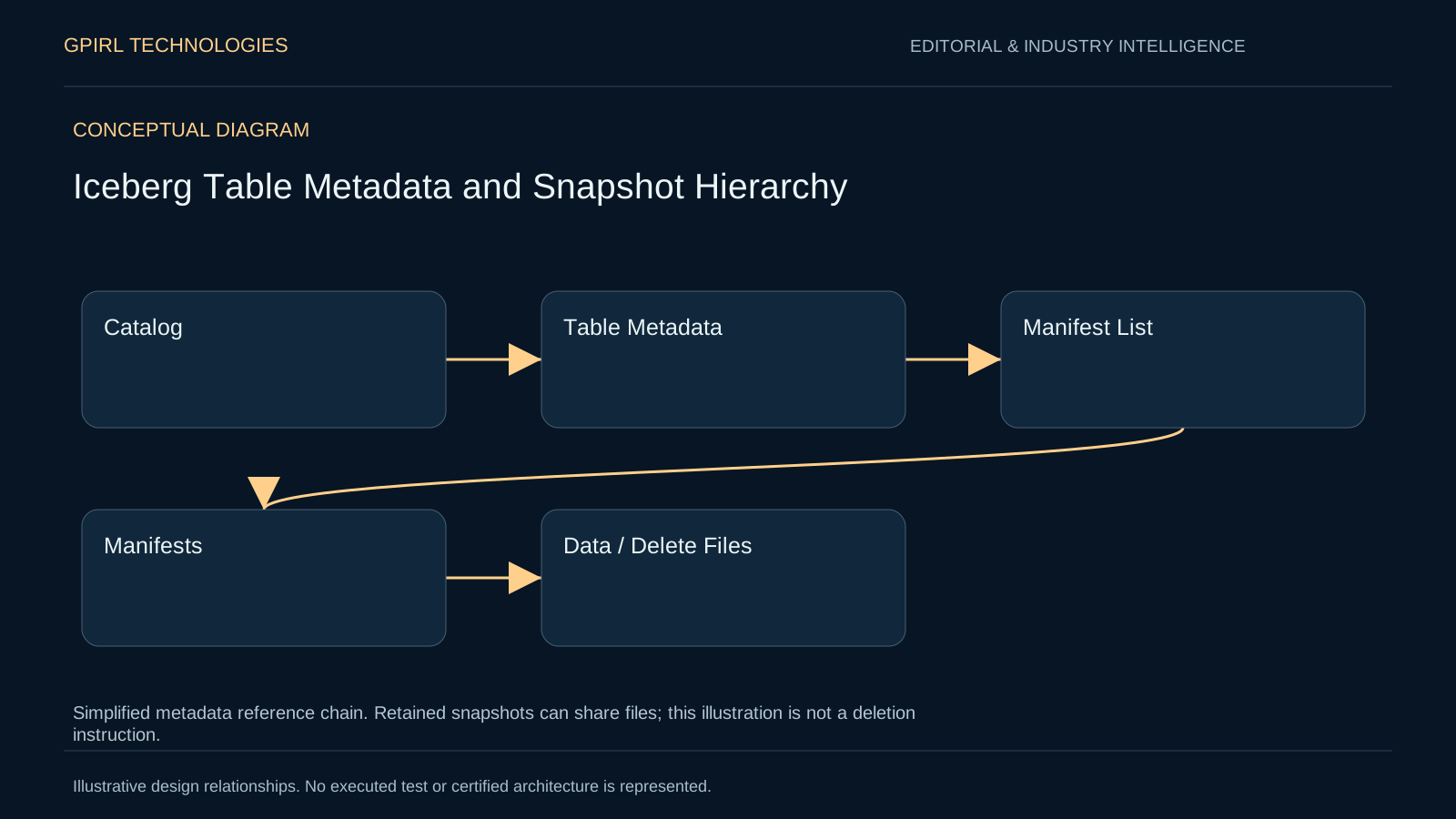
Apache Iceberg provides ACID transactions and table-format abstractions on object storage systems like Amazon S3, Google Cloud Storage, and Azure Blob Storage. At the heart of Iceberg's transactional capability lies its hierarchical metadata structure. Unlike traditional Hive-style partitioned tables that rely on directory listings to discover data files, Iceberg maintains a versioned tree of metadata files, manifest lists, and manifest files that track data files associated with a table.
When a write operation—such as an insert, update, or delete—occurs on an Iceberg table, the engine generates metadata files and a corresponding snapshot. According to the official Apache Iceberg table specification, a snapshot represents the state of a table at a specific point in time, identifying the manifest list that points to data files active in that transaction [S2]. New table metadata references the current snapshot; the catalog implementation provides the atomic metadata commit. A metadata-only change need not create a new data snapshot [S2].
Understanding this hierarchical pointer structure is useful for data platform engineers. Because data files are immutable once written, updates and deletions do not overwrite existing files on disk. Depending on the operation and table-format features, a change can create replacement data files or delete files and a new snapshot. Older files can remain reachable through retained snapshots [S2]. This immutable design underpins capabilities like time travel and rollback, but it also introduces storage management responsibilities requiring operational governance.
Mechanics of Time Travel and Query Reproducibility
Lakehouse table formats support time travel, allowing data analysts and data scientists to query a table as it existed at a specific timestamp or snapshot ID. Because Iceberg retains historical snapshot pointers within metadata JSON files, query engines can resolve queries against past table states without duplicating underlying data files. This capability assists auditing, reproducibility, and feature store engineering by ensuring that analytical queries can reference specific table states.
However, time travel is not an infinite or cost-free capability. Every historical snapshot references underlying data and manifest files. If data modification operations (such as row-level updates or deletes using copy-on-write or merge-on-read mechanisms) continuously rewrite data files, older snapshots continue to reference older data files to satisfy time travel queries. Consequently, retaining historical snapshots indefinitely contributes to storage accumulation and cloud storage costs.
Engineering teams can establish policies governing how far back time travel queries are supported. Balancing analytical utility against storage expenditure requires defining retention windows tailored to business workloads. A financial auditing table might require a defined retention window, whereas a high-frequency telemetry ingestion table may need a shorter window before historical snapshots are expired and cleaned up.
Snapshot Expiration and Orphan File Removal
To manage storage accumulation, Apache Iceberg provides built-in maintenance procedures for expiring old snapshots and removing orphan files. According to the official Iceberg maintenance documentation, snapshot expiration removes historical snapshot references from table metadata, unlinking old manifest lists and data files no longer required by active snapshots or retention windows [S1]. Once expired, these files can become candidates for physical deletion from object storage.
In addition to snapshot expiration, tables accumulate orphan files—files residing in storage locations no longer referenced by metadata pointers due to failed jobs, aborted transactions, or manual uploads. Orphan file removal procedures scan object storage buckets, compare discovered files against active metadata manifests, and purge unreferenced artifacts. A cleanup review should use a retention interval longer than relevant in-progress writes and account for concurrent jobs, path handling and shared storage. The proposed staging check should identify candidates before deletion; a quiet traffic period alone does not establish safety [S1].
However, executing maintenance commands requires operational caution. If snapshot expiration policies are configured with aggressive retention windows, long-running analytical queries referencing older snapshots can encounter file-not-found exceptions. Maintenance procedures can be scheduled and coordinated with active query workloads and backup schedules.
Logical Deletion Versus Physical Erasure Realities
A consideration in data governance is whether executing row-level deletes or running table maintenance routines guarantees absolute physical erasure of sensitive data. In distributed data lakehouses, logical deletion—such as filtering out records via delete manifests or expiring snapshots—does not instantly erase data bytes from physical storage media or object storage replication layers. Even after snapshot expiration and orphan file cleanup routines complete, residual copies can persist in storage backups, cross-region replicas, or object storage versioning histories.
When organizations face regulatory compliance mandates requiring data erasure, relying solely on Iceberg maintenance commands is insufficient. Object storage versioning, for instance, preserves previous versions of deleted or overwritten metadata and data files unless explicit lifecycle policies purge noncurrent object versions. Data platform engineers coordinate lakehouse maintenance procedures with cloud infrastructure storage policies to ensure data lifecycle alignment.
Furthermore, distinguishing between logical table updates and physical data destruction helps clarify compliance scope. Lakehouse table formats manage logical visibility; they do not control low-level cloud storage durability, erasure coding mechanics, or archival backup vaults. Governance frameworks can document these boundaries for legal and compliance teams.
Hypothetical Tabletop Scenario: Evaluating Retention Policies
Consider a hypothetical tabletop exercise conducted by a data platform team managing a large e-commerce data lakehouse. The team reviews current snapshot retention configurations on core transaction tables that experience high daily write volumes and frequent updates.
During the tabletop simulation, the team evaluates the impact of adjusting snapshot expiration windows from 30 days to 14 days. Rather than asserting an outcome, the team models storage usage projections and verifies whether any active data science workflows rely on 30-day time travel queries. They also test orphan file removal scripts in a staging bucket to verify that unreferenced files are correctly identified without impacting active table manifests.
This hypothetical tabletop exercise illustrates how platform teams analyze retention tradeoffs, balancing storage cost optimization against analytical time-travel requirements without assuming automated cost reductions.
Managing Branches, Tags, and Retention Policies
Beyond linear snapshot history, Apache Iceberg specifications support branch and tag management capabilities, as detailed in official branching documentation [S3]. Similar to version control branching models, Iceberg allows data engineers to create named branches and tags pointing to specific table snapshots. This enables workflows such as isolating experimental ETL pipelines on separate branches, executing write validations before merging into main production branches, and tagging specific snapshots for compliance auditing.
However, branches and tags introduce retention complexity. Expiring old snapshots based on age or count does not automatically remove snapshots referenced by active branches or tags. A branch or tag can retain references that the team otherwise expected to expire. Reference age and branch snapshot-retention settings determine what remains; a live branch does not necessarily retain its entire ancestral history forever [S3].
Governance frameworks can establish lifecycle rules for table branches and tags. Automated monitoring can track active branches, alerting platform owners when branches exceed specified age limits. Integrating branch lifecycle management into data engineering workflows helps prevent experimental work from retaining obsolete data.
Storage Backups and Infrastructure Interdependencies
Lakehouse table maintenance interacts with enterprise disaster recovery and backup strategies. When planning snapshot expiration and orphan file removal policies, engineering teams evaluate how table-level maintenance interacts with cloud storage backups, point-in-time recovery (PITR) features, and cross-region replication services.
If an organization relies on cloud object storage PITR to protect against data corruption, physical file deletions executed by Iceberg maintenance routines can be captured and retained by storage provider backup tiers, impacting storage costs. Conversely, if storage versioning is enabled without coordination, deleted files can linger in noncurrent storage tiers, rendering Iceberg cleanup routines partially limited in cost reduction.
Architects design data protection strategies that harmonize lakehouse snapshot retention with cloud infrastructure backup policies. Regular restoration drills verify that disaster recovery procedures can reconstruct table states from backup vaults without depending on expired historical snapshots.
Operational Decision Checklist for Lakehouse Maintenance
To ensure structured execution of Apache Iceberg table maintenance, data engineering and platform teams can utilize a decision checklist:
1. Retention Policy Definition: Are snapshot retention windows and time-travel horizons defined based on business and auditing requirements?
2. Maintenance Scheduling: Are snapshot expiration and orphan file removal jobs scheduled to avoid query contention?
3. Branch and Tag Auditing: Are table branches and tags cataloged and monitored for expiration to manage storage?
4. Storage Versioning Coordination: Are object storage versioning and backup policies aligned with Iceberg cleanup procedures?
5. Query Workload Impact: Have analytical query dependencies been accounted for before purging historical snapshots?
6. Monitoring and Alerting: Are storage consumption and maintenance job failure metrics monitored by platform engineering?
Limitations and Compliance Boundaries in Storage Systems
It is important to recognize the technical limitations and compliance boundaries inherent in data lakehouse maintenance systems. Apache Iceberg table formats manage logical table state and transactional consistency, but they do not guarantee regulatory erasure, absolute data immutability, or immunity to cloud storage misconfigurations. Editorial proposals and architectural recommendations provide structured guidance, but they are adapted to the legal, regulatory, and infrastructural environment of each enterprise.
Furthermore, maintenance commands are computationally intensive operations that consume cluster compute resources and object storage API call quotas. Execution during peak analytical hours can impact query performance. Engineering teams balance storage cost optimization against computational overhead.
Ultimately, lakehouse maintenance requires collaboration between data platform engineers, security officers, and finance teams. By establishing transparent retention policies, automated cleanup pipelines, and governance oversight, organizations can utilize Apache Iceberg snapshots while maintaining operational stability.
Official background videos
External publisher context. These recordings do not demonstrate GPIRL products or validate the proposed designs.
- Implementing Intelligent Snapshot Management
Official Apache Iceberg project-channel recording from Iceberg Summit 2026. A speaker's snapshot/tag retention implementation as background; not a universal retention recipe or proof of erasure.
Sources and further reading
- [S1] Apache Iceberg Maintenance Documentation
- [S2] Apache Iceberg Table Specification
- [S3] Apache Iceberg Branching and Tagging Documentation
References do not imply product certification or endorsement.
Have a related operational question? If your analytics engineering team is optimizing data lakehouse maintenance policies, let's discuss your table lifecycle.