Introduction: The Provenance Imperative in Enterprise Data Systems
This article asks an architectural question: what evidence would a reviewer need to trace the inputs and processing steps behind an automated decision? W3C PROV-O and OpenLineage provide useful concepts for discussing that question, but neither source establishes a universal audit-acceptance requirement or a measured trend in enterprise demand [S1] [S2]. Data lineage addresses this transparency requirement by capturing the historical lifecycle of information as it flows from raw ingestion datasets through transformation processes to final analytical outcomes [S1] [S2].
Establishing comprehensive data lineage transforms opaque information flows into traceable knowledge assets that support internal auditing and governance reviews [S1] [S2]. However, designing effective lineage architecture requires understanding that captured metadata represents recorded process history rather than an absolute guarantee of data accuracy or correctness [S1] [S2]. Technical architects must implement structured tracking frameworks that record data transformations reliably across heterogeneous enterprise systems [S1] [S2]. Recognizing the scope and limits of lineage collection is essential for building accountable data ecosystems [S1] [S2].
Theoretical Foundations: Entities, Activities, and Agents in W3C PROV
Standardizing provenance tracking across diverse information systems requires robust theoretical models capable of representing complex data relationships within enterprise environments [S1]. The World Wide Web Consortium PROV data model establishes an interoperable framework for generating provenance records on the web [S1]. The PROV ontology models information around three core concepts: Entities, which represent physical or digital objects; Activities, which describe things occurring over time that involve entities, including computational or other processes; and Agents, which denote the people or software components responsible for those activities [S1].
By defining explicit relationships such as wasGeneratedBy, wasDerivedFrom, and wasAssociatedWith, the PROV model enables organizations to construct provenance graphs describing the selected relationships [S1]. These conceptual structures provide a standardized vocabulary for describing how datasets evolve over time through series of computational transformations [S1]. While PROV offers an invaluable semantic foundation, it represents a conceptual framework rather than an automated software implementation or a complete data governance program [S1]. These primitives provide shared terms for reviewing the proposed graph here; the discussion does not require every operational lineage system to implement PROV.
Operationalizing Metadata: The OpenLineage Object Model Specification
Translating abstract provenance theory into cloud-native data pipelines requires standardized metadata collection specifications such as OpenLineage [S2]. The OpenLineage object model defines a common schema for capturing runtime metadata across jobs, runs, and datasets in modern data processing engines [S2]. In the checked object-model documentation, version 1.54.0 is displayed. Jobs, runs and datasets can carry extensible facets, and additional design-time job or dataset metadata events are also described. SQL, source-code version, schema and dataset-version details depend on the facets and integration instrumentation actually supplied [S2]. A consumer must distinguish an absent observation from an empty or negative result instead of inventing a missing query or commit reference.
Captured runtime metadata can identify dependencies to investigate when an upstream dataset changes; establishing the effect on a model or dashboard requires additional evidence rather than the dependency edge alone [S2]. However, the OpenLineage specification defines data structures and event formats rather than enforcing mandatory data quality standards or guaranteeing pipeline correctness [S2]. The proposed implementation review should examine instrumentation coverage, identifier consistency, event delivery and how the backend processes incomplete observations. Those checks go beyond merely recognising the object-model field names. Operationalizing metadata collection requires rigorous engineering discipline and continuous maintenance across all pipeline components [S2].
Worked Derivation Graph: Tracing Data from Ingestion to Inference
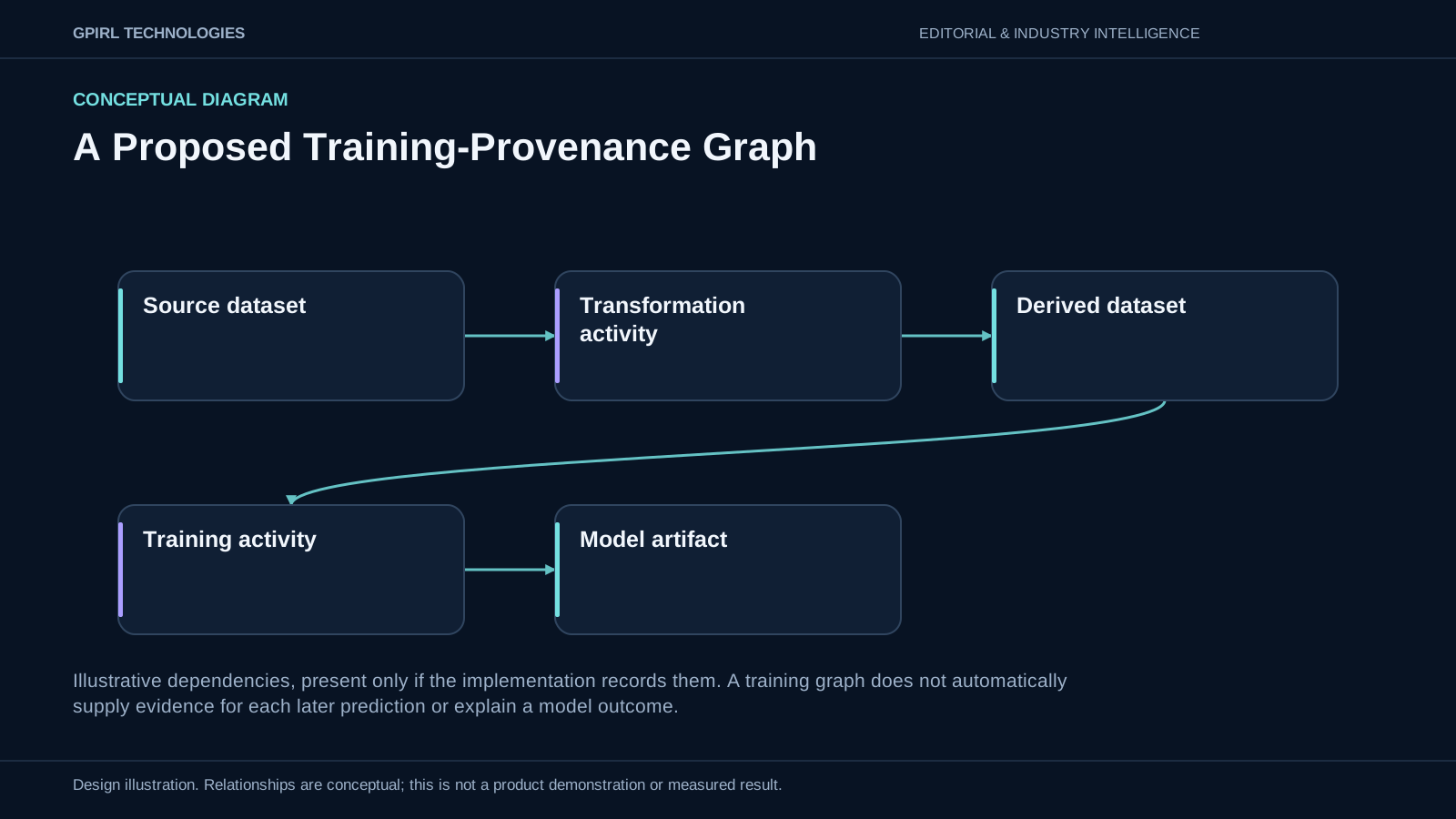
Constructing a worked derivation graph illustrates how data flows from initial source ingestion through feature engineering to final model inference [S1] [S2]. In this conceptual model, the raw ingestion dataset functions as a PROV Entity that is consumed by a data cleaning Activity, producing an intermediate feature store Entity [S1]. Subsequently, a machine learning training job—modeled as a distinct Activity associated with a data science Agent—consumes the feature set to generate the final model artifact Entity [S1] [S2].
In this proposed example, tracing input partitions would be possible only if the implementation captured those identifiers and preserved a reliable join to the training run. The vocabulary does not populate every node with versions automatically. A training-run graph also does not necessarily identify the inputs to each later prediction. Reviewers should mark such missing links as unknown and state the granularity actually available [S1] [S2]. While this derivation graph provides clear visibility into processing history, it does not verify whether the original source data was factually correct or free from bias [S1] [S2]. Provenance graphs document processing pathways rather than certifying data quality or truthfulness [S1] [S2].
Synthetic Scenario: Investigating Algorithmic Decision Outputs
Consider a synthetic enterprise scenario where a financial institution utilizes an automated credit scoring model to evaluate loan applications across regional branches [S1] [S2]. When an internal review committee questions why a specific applicant's score shifted unexpectedly between weekly scoring batches, data engineers investigate using OpenLineage metadata records [S2]. By querying the lineage graph, engineers trace the model output back through the feature engineering pipeline to the specific daily transaction table partition ingested prior to execution [S2].
In the proposed investigation, the graph would identify a currency conversion table as one input to examine. Investigators would still need the relevant table versions, transformation logic, feature values and model evidence to test whether a scaling discrepancy affected the score. A dependency edge alone would not establish that causal explanation. This is an unexecuted illustrative investigation, with no reported improvement in analysis time [S1] [S2]. However, the lineage graph only documents that the conversion table was consumed; it does not prove that the underlying currency exchange rates provided by the external vendor were accurate or legally compliant [S1] [S2]. Lineage aids investigation without guaranteeing absolute data correctness [S1] [S2].
Technical Limits, Missing Metadata, and Scalability Bottlenecks
Maintaining comprehensive data lineage across large-scale enterprise environments introduces notable technical limits and scalability bottlenecks [S1] [S2]. For a proposed high-volume streaming workload, capturing granular lineage metadata for every individual record can overwhelm storage backends and degrade pipeline performance [S2]. Furthermore, missing metadata represents a persistent operational obstacle; whenever developers introduce uninstrumented custom scripts, ad-hoc queries, or unsupported third-party transformation tools into a pipeline, lineage graphs fracture and create blind spots where provenance is lost [S1] [S2].
One proposed engineering policy is to review instrumentation when a pipeline changes, prioritising paths whose missing evidence would affect a decision. That is a local design choice, not an OpenLineage requirement for every new pipeline. A review should state which integrations remain uncovered and why. Missing coverage limits which derivations can be substantiated. A review should name the paths and relationship types actually observed [S1] [S2]. Accepting these technical boundaries prevents engineering teams from assuming absolute lineage coverage across legacy systems [S1] [S2]. Pragmatic lineage engineering focuses on critical paths and high-value data assets while managing collection overhead effectively [S1] [S2].
Governance Realities: Provenance as Evidence, Not Absolute Truth
Data lineage serves as a vital pillar of modern data governance, providing the evidentiary backbone required to understand complex algorithmic outcomes [S1] [S2]. By adopting open standards such as W3C PROV and OpenLineage, organizations construct transparent provenance graphs that illuminate data dependencies and processing history [S1] [S2]. However, technical leaders must maintain a clear perspective on what lineage records actually provide [S1] [S2]. Provenance metadata documents how data was processed, but it does not constitute proof of legal compliance, regulatory approval, or absolute factual accuracy [S1] [S2].
Effective data governance integrates lineage tracking with rigorous data quality validation, human oversight, and compliance reviews to establish a truly accountable organizational data culture [S1] [S2]. Treating lineage as a powerful diagnostic tool rather than an infallible guarantee of correctness ensures that organizations maintain realistic expectations during audits [S1] [S2]. As enterprise data ecosystems continue to expand in scale and complexity, disciplined provenance engineering remains an indispensable discipline for accountable technical management [S1] [S2].
Official background videos
External publisher context. These recordings do not demonstrate GPIRL products or validate the proposed designs.
- NIST — NIST AI Risk Management Framework (AI RMF 1.0) Launch
Historical AI-risk governance context for accountable decision evidence; it is not a PROV-O or OpenLineage implementation tutorial.
Sources and further reading
References do not imply product certification or endorsement.
Have a related operational question? Bring this question to a GPIRL Technologies discovery discussion.