The Technical Realities of Additive Schema Changes
In distributed data architectures and event-driven systems, schema evolution is an operational requirement. Producers and consumers update data contracts over time to accommodate new business features, regulatory requirements, and telemetry enhancements. A common assumption among data engineers is that making a schema change additive—such as introducing a new optional field—is safe and backward compatible. However, operational experience across streaming pipelines reveals that additive changes can break downstream consumers if serialization rules and default values are mismanaged.
The perception that additive changes are riskless often stems from misunderstandings of how serialization formats handle missing data, default values, and unknown field propagation. When a producer serializes an event with a newly added optional field, consumers running older schema versions parse incoming payloads according to their reader schema. If a consumer's parser encounters structural assumptions it cannot reconcile, or if default values are improperly configured in reader schemas, deserialization exceptions can occur, potentially impacting streaming ingestion.
Consequently, managing schema evolution requires understanding format-specific resolution rules. Formats like Apache Avro and Protocol Buffers enforce distinct compatibility semantics that dictate how readers interpret writer schemas. Treating schema registries and serialization protocols as interchangeable risks production friction. Data architects can analyze how each serialization format handles reader-writer schema mapping before deploying additive changes to pipelines.
Apache Avro Reader-Writer Resolution by Name
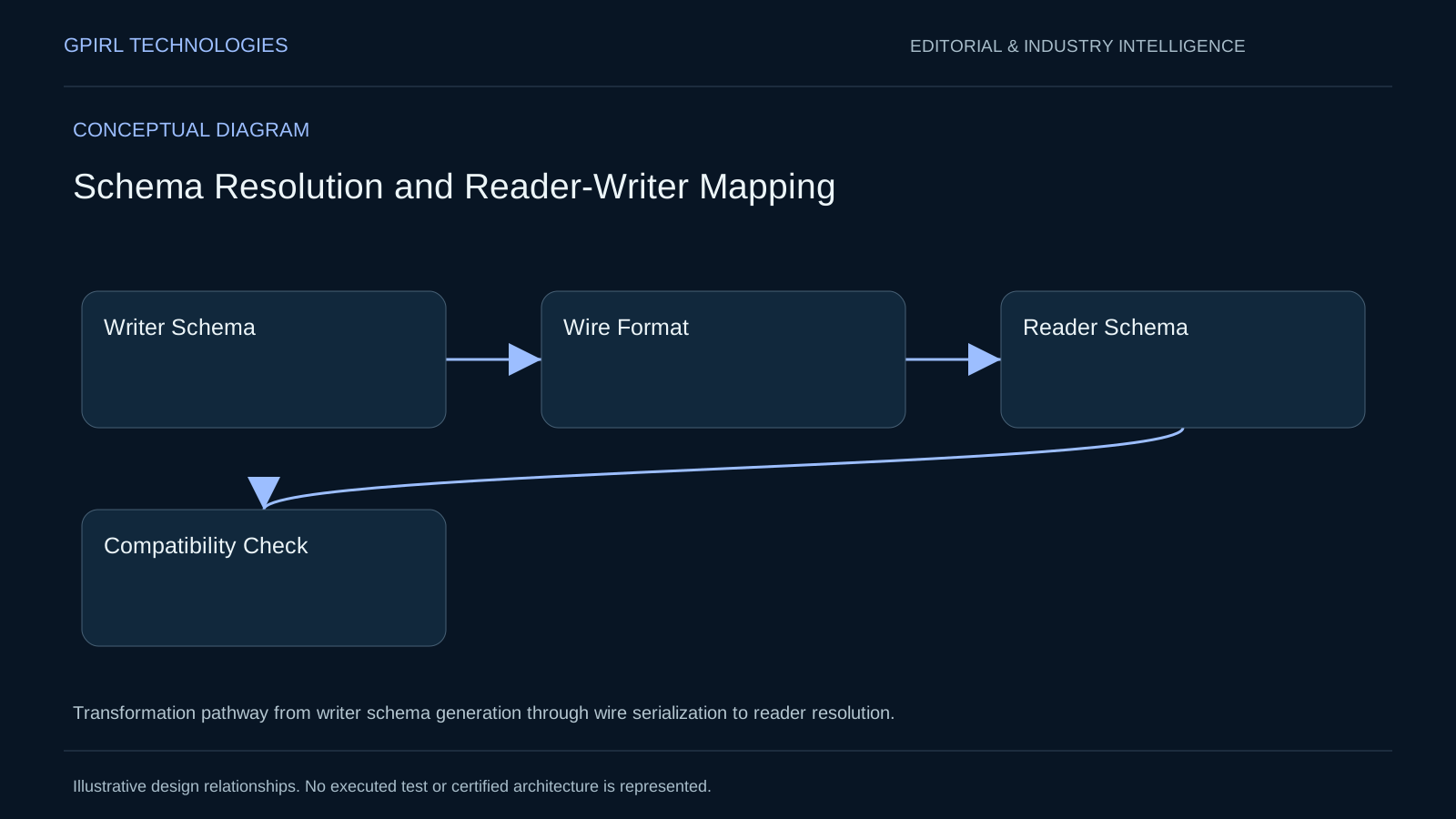
Apache Avro relies on explicit reader-writer resolution rules defined in the official specification [S1]. In Avro, records are resolved fields by name, meaning field ordering in the schema does not restrict compatibility. When a reader processes a record, Avro compares the writer schema against the reader schema field by field, resolving differences based on naming and type promotion criteria.
When an additive field is introduced in a writer schema, Avro's resolution rules dictate that if the reader schema does not contain the new field, the reader simply ignores it during deserialization. Thus, an older reader does not require a default value for a writer field it does not contain. Conversely, if a reader schema includes a new field that was absent in the writer schema, Avro requires that the new field have a defined default value in the reader schema. If the reader has no explicit default for that absent writer field, resolution signals an error; a union allowing null does not itself supply a default [S1].
This mechanism highlights the importance of default value governance in Avro reader schemas. When new readers must accept older records missing the field, their Avro schema needs a suitable explicit default. A default is used on reading and does not make a field optional when encoding [S1]. Furthermore, Avro's reliance on field name matching and type promotion rules means that renaming a field or altering its type hierarchy requires planned schema evolution strategies rather than simple updates.
Protocol Buffers Proto3 Wire Compatibility Rules
Protocol Buffers (protobuf) adopts a different approach to schema evolution. According to the official proto3 updating guidance, protobuf relies on tag numbers (field identifiers) rather than field names or positional ordering to serialize and deserialize messages [S2]. Every field in a proto3 message definition is tagged with a unique numerical identifier that remains immutable throughout the lifecycle of the message.
In proto3, adding a new field is designed to be wire-compatible under documented constraints. When an older consumer receives a message containing a newly added field tag it does not recognize, the protobuf parser treats the field as an unknown field. Proto3 binary messages preserve unknown fields; JSON conversion and field-by-field copying are documented ways to lose them [S2]. For missing scalar fields, getters can expose a zero-equivalent default, but explicit optional presence can distinguish absence from an explicitly supplied default. That distinction belongs in the test cases.
However, this flexibility requires governance. Because proto3 allows unknown fields to pass through older consumers, complex multi-hop pipelines where data is read, modified, and re-written can inadvertently strip out unknown fields if older services fail to preserve them. Wire compatibility does not automatically equate to semantic application compatibility, requiring adherence to versioning policies.
Default Values, Nullability, and Missing Fields
The handling of missing data, null values, and defaults represents an area in schema design. In many programming languages and database systems, a null value indicates the intentional absence of data. In serialization protocols, however, a missing field and an explicitly null field can be treated with distinct semantic weight, leading to ambiguity between producers and consumers.
When introducing additive fields, engineers distinguish between optional fields that omit values when absent and fields that require explicit default fallbacks. For instance, if an e-commerce event schema adds an optional discount percentage field, an older producer omits the field entirely. A consumer processing this message decides whether a missing discount field represents zero percent, unknown status, or inapplicable context. Conflating missing fields with explicit zero values can corrupt downstream analytics.
Establishing organizational conventions around nullability and default values is useful. Data governance frameworks can mandate that additive fields include documented default values in reader and writer schemas where appropriate. Furthermore, API contracts can specify whether consumer applications handle missing fields via default fallbacks or reject payloads deviating from expected structural norms.
Hypothetical Tabletop Scenario: Replay and Schema Testing
Consider a hypothetical tabletop exercise conducted by a data platform engineering team. The proposed fixtures define an old writer without 'device_firmware_version' and a new reader containing it. The team would test that replay direction with and without an explicit reader default. A separate fixture would send the new writer's extra field to the old reader, where Avro resolution ignores it [S1].
The expected result for the absent-field fixture is a resolution error without the required reader default, and schema-level resolution when a valid default is supplied. The exercise should then check business meaning independently: a default such as "unknown" is not evidence of a device firmware version. These are proposed checks, not measured production outcomes.
This hypothetical tabletop exercise illustrates how testing compatibility across reader-writer combinations in a staging environment helps engineering teams validate schema evolution practices before deploying changes to live streaming pipelines.
Unknown Field Handling Across Heterogeneous Consumers
In microservice architectures, data flows through multi-tier processing pipelines where messages pass through transformation and enrichment services before landing in data storage. In such environments, unknown field handling is an architectural consideration. When a service reads a message, modifies a subset of fields, and emits a new message downstream, it acts as an intermediary consumer-producer.
If intermediary services use serialization libraries that discard unknown fields upon deserialization, additive fields introduced upstream can be stripped out before reaching downstream analytics consumers. This phenomenon—schema clipping or data erosion—undermines additive evolution. Ensuring data fidelity requires intermediary services to support transparent unknown field retention and forwarding.
Data governance teams can audit serialization libraries across participating services to ensure consistent unknown field handling. An Avro intermediary projecting into an older record schema should not be assumed to retain fields it ignored. The proposed contract can require original-message preservation, an appropriate writer schema, or an explicit transformation record. For protobuf, test the actual binary copy path and any JSON boundary separately.
Staged Rollout Strategies and Versioning Policies
Deploying schema changes safely involves structured, staged rollout strategies. A schema evolution lifecycle begins in development environments with automated compatibility testing tools integrated into CI/CD pipelines. Schema registries can be configured to enforce backward and forward compatibility modes, rejecting schema pushes that violate existing consumer contracts.
When executing additive schema changes, engineering teams can follow a phased deployment sequence: First, update and deploy consumer applications to ensure they can parse future schemas (forward compatibility). Second, update the schema registry to register new schema versions with default values. Third, deploy updated producer applications emitting new additive fields. This sequence helps ensure consumers are prepared for new fields.
Establishing semantic versioning policies for data schemas provides predictable boundaries. Breaking changes—such as renaming fields, changing data types incompatibly, or removing required fields—trigger major schema version increments and require coordinated migration windows. Additive changes, governed by default handling, occur within minor version increments under a locally chosen deployment policy. Semantic version labels are a team convention, not an additional compatibility guarantee from either wire-format specification.
Comprehensive Schema Evolution Decision Checklist
To ensure schema evolution initiatives maintain data integrity and prevent consumer issues, engineering teams can utilize a decision checklist:
1. Compatibility Mode Verification: Is the schema registry configured to enforce backward and forward compatibility checks?
2. Default Value Definition: Do newly added optional fields include explicit default values in reader schemas where required?
3. Deployment Direction: Does the chosen producer-first or consumer-first rollout pass old/new writer-reader combinations, historical replay and intermediary transformations?
4. Intermediary Field Preservation: Do microservice intermediaries preserve unknown fields without truncation?
5. Semantic Clarity: Is the business meaning of missing fields versus explicit null values documented for consumers?
6. Automated Pipeline Testing: Are schema diffing and compatibility tests integrated into CI/CD build pipelines?
Technical Limitations and Format-Specific Divergences
It is vital to recognize the technical limitations and format-specific divergences governing schema evolution. Rules that apply to Apache Avro—such as explicit default value enforcement in reader schemas—do not directly translate to Protocol Buffers, JSON Schema, or Apache Thrift. Generalizing the behavior of one serialization format across a multi-format enterprise architecture can lead to integration errors.
Furthermore, schema registries and automated compatibility checks do not replace domain understanding. A schema change may be technically compatible according to registry algorithms yet violate semantic expectations downstream. For example, adding an optional numeric field representing currency values without specifying currency code can lead to financial reconciliation errors, even if the parser successfully decodes the number.
Ultimately, schema evolution is an organizational governance challenge as well as a technical procedure. Clear lines of ownership, transparent data contracts, and staged protocols are essential for maintaining stable data pipelines in distributed systems. Editorial proposals and architectural guidelines provide a roadmap, but successful execution depends on cross-team collaboration and testing.
Official background videos
External publisher context. These recordings do not demonstrate GPIRL products or validate the proposed designs.
- Evolve Existing Schemas (Hands-On Exercise) | Schema Registry 101
Official Confluent training on Avro and protobuf evolution and compatibility. Vendor-specific tooling example; it is not a requirement to use a registry for all Avro deployments.
Sources and further reading
References do not imply product certification or endorsement.
Have a related operational question? If you are designing robust event streaming schemas across distributed teams, we invite you to explore our governance insights.