DICOM Architecture and Conformance Scope Boundaries
Medical imaging interoperability relies on the Digital Imaging and Communications in Medicine standard to govern data formatting, transmission, and storage across healthcare networks. A declaration of conformance should not be read as a guarantee of seamless, plug-and-play interoperability between a particular pair of hospital systems. PS3.2 describes the conformance framework and its scope; it does not specify testing procedures or certify clinical performance. [S3] Local integration testing is an editorial recommendation here, rather than a test result or a clinical instruction.
The DICOM standard encompasses a vast ecosystem of specifications, including part-level definitions that govern data elements, transfer syntaxes, and service object pairs. A conformance statement documents an implementation's declared capabilities; the declaration and observed behavior remain different kinds of evidence. [S3] However, these documents do not prescribe universal testing procedures or validate the clinical accuracy of rendered pixel data. Understanding that scope helps frame an integration review, without a promise that a migration will avoid failures or costs.
Value Multiplicity Versus Data Types in Element Definitions
Managing DICOM data elements requires careful attention to structural properties such as Value Multiplicity, which specifies how many Values can be encoded in a Data Element's Value Field. [S4] Value Multiplicity is distinct from Value Representation, which describes a Value's data type and format, such as a character string or binary integer. [S5] Misinterpreting these structural rules during image parsing is a potential parser failure to investigate, rather than a measured rate of corruption established by this article. Software developers must implement strict validation parsers that respect exact specification definitions.
VM can permit multiple Values within an element, but the permitted multiplicity belongs to the specific element definition rather than a blanket rule for every attribute. [S4] Delimitation depends on the encoding: multi-valued character strings use a backslash, while fixed-length binary Values are concatenated without a delimiter. [S4] A proposed parser review would check representative element types and record how invalid multiplicities are handled. Passing those checks would not guarantee data fidelity across every subsequent transformation in the imaging pipeline.
Non-Image Objects and Attribute Dependency Rules
DICOM includes more than ordinary image objects: PS3.3 describes structured-report documents and waveforms as well as images. [S7] Required, conditional, and optional attributes vary significantly depending on the specific information object definition being processed by the clinical workstation. Assuming that every attribute is populated across all object types ignores different presence and value requirements; an empty Type 2 value is not equivalent to omitting a Type 1 element. [S1] A proposed review evaluates attribute dependencies against the relevant object definition rather than requiring every optional attribute everywhere.
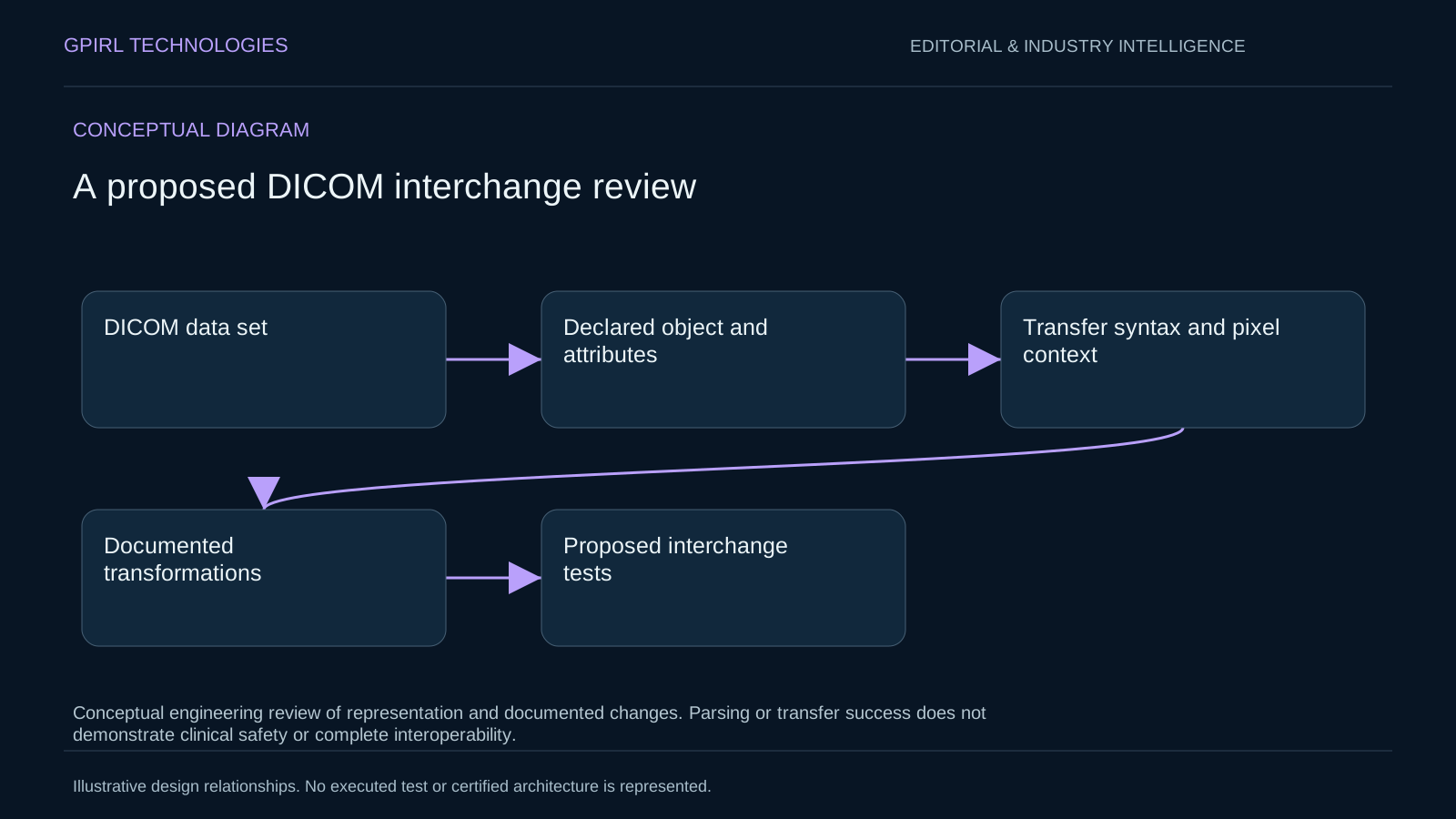
Conditional attributes within DICOM objects require sophisticated parsing logic because their presence depends on the values of other related data elements in the header. For the Image Pixel Module, relevant elements include Rows, Columns, Samples per Pixel, Photometric Interpretation and the applicable bit-related attributes. [S2] If an imaging application fails to evaluate these inter-element dependencies, the receiver may interpret the data differently from what the sender intended. A proposed technical check therefore pairs representative Pixel Data with its related metadata and documents the object types covered by that check.
Pixel Module Attributes and Transfer Syntax Encoding
Pixel data interpretation within DICOM files depends heavily on the pixel module attributes and the specific transfer syntax utilized during image encoding and transmission. Transfer Syntax specifies encoding choices, including explicit or implicit VR and applicable Pixel Data encoding; both element structures still contain a Tag. [S1] A receiver's supported Transfer Syntaxes need to be compared with those used by the sender; this does not require every implementation to support every syntax. An unsupported encoding is a concrete compatibility question to test, not a prediction of a particular display failure.
Pixel module attributes define critical parameters such as bits allocated, bits stored, high bit positioning, and photometric interpretation where required by the relevant object and encoding. [S2] A review would check how these parameters are interpreted instead of assuming that transferring the byte array alone preserves the intended image representation. DICOM conformance statements outline which transfer syntaxes a device supports, but local integration testing remains vital to confirm visual fidelity. The checks proposed here address representation and exchange, not the clinical suitability of a viewing workstation.
Private Tags, De-Identification, and Data Transformation
DICOM defines Private Data Elements; their presence and meaning need to be evaluated in the context of the particular dataset and implementation. [S1] A common misconception is that every private tag must be permanently retained across all data exchanges and archiving operations. PS3.15 defines attribute confidentiality profiles with removal, replacement and retention actions; it explicitly warns that applying them does not guarantee removal of all identifying information. [S6] A proposed transformation review establishes explicit policies governing private tag handling during research exports.
When medical datasets are prepared for machine learning research or multi-center clinical trials, de-identification can involve changing attributes; that is a separate purpose from preserving an unchanged original clinical dataset. [S6] However, transforming DICOM headers must be executed carefully to avoid accidentally stripping essential clinical attributes required for accurate image interpretation. The applicable profile, options and intended use need to be documented; selecting a tool or removing private elements alone does not establish privacy compliance. [S6] A proposed change log would record the modifications actually made, together with any unresolved effects on the intended dataset use.
Synthetic Tabletop Cases in DICOM Interoperability Testing
This proposed synthetic tabletop case has not been executed: a fictional dataset would be tested with an altered VM, a missing conditional attribute and an unsupported Transfer Syntax. The exercise would use artificial data in an isolated review environment, with no patient case, clinical finding or GPIRL product performance claim. By introducing artificially malformed DICOM files, reviewers would record whether each object is accepted, rejected or misinterpreted; graceful rejection is a test question rather than an assumed result. No clinical safety outcome follows from this proposed exercise.
Tabletop testing scenarios also examine how viewing software handles unusual Value Multiplicity arrays and non-standard private tag structures encountered during external image imports. Analysts would compare the parsed metadata and representation with the fictional fixture's expected structure, without making a diagnostic-accuracy claim. Documenting the outcomes of these synthetic tests could inform the next review while making its limited coverage explicit. A successful fixture test would not prove compatibility with every modality, object type, institution or future software version.
Avoiding Clinical Misinterpretations and Unverified Claims
Maintaining rigorous clinical safety standards requires hospital administrators to avoid unverified claims regarding automated diagnostic accuracy or universal DICOM compliance guarantees. A claim of plug-and-play compatibility should identify the actual systems, object types, versions and evidence on which it rests; no vendor behavior is alleged here. A technical review can compare empirical tests with conformance documentation rather than marketing assertions when procuring imaging informatics solutions. This is a discussion of exchange evidence, not advice on diagnosis, treatment or workstation approval.
This article separates technical interpretation of a dataset from clinical assessment of the information displayed; the latter requires its own appropriately qualified process. A proposed technical review can document encoding and transformation discrepancies, but it cannot promise to prevent diagnostic errors. Responsibilities for clinical use, privacy and legal compliance are outside this deep dive's determination. Continuous staff training and robust IT governance form the bedrock of safe medical imaging operations.
Strategic Governance of Medical Imaging Standards
Effective governance of medical imaging data standards requires active collaboration between radiologists, biomedical engineers, and software developers within healthcare enterprises. As imaging modalities generate increasingly complex volumetric datasets, maintaining data integrity and interoperability becomes progressively challenging. One possible governance arrangement assigns named reviewers to check whether DICOM archiving and viewing systems adhere to established technical specifications. The useful output is a documented decision about the covered exchange and its remaining uncertainties, not a universal assurance.
The continuous evolution of the DICOM standard demands that healthcare IT departments maintain dynamic knowledge bases and flexible integration architectures. By focusing on rigorous conformance verification, thoughtful data transformation policies, and comprehensive tabletop testing, teams can make the evidence behind a compatibility claim more inspectable. The narrower objective here is to preserve the intended representation through the specific exchange under review, with transformations and unsupported cases made explicit. These principles do not establish flawless interoperability or a clinical outcome.
Official background videos
External publisher context. These recordings do not demonstrate GPIRL products or validate the proposed designs.
- Introduction to the Portal, NCI Imaging Data Commons
Official NCI introduction shows an imaging-data portal built around DICOM images and metadata. It provides a concrete research-data context for the distinction between image content and metadata; it is not a DICOM2026d encoding tutorial or a conformance certification.
Sources and further reading
- [S1] DICOM PS3.5 2026d Data Set
- [S2] DICOM PS3.3 2026d Image Pixel Module
- [S3] DICOM PS3.2 2026d Conformance scope
- [S4] DICOM PS3.5 2026d, 6.4 Value Multiplicity and Delimitation
- [S5] DICOM PS3.5 2026d, 6.2 Value Representation
- [S6] DICOM PS3.15 2026d, Annex E Attribute Confidentiality Profiles
- [S7] DICOM PS3.3 2026d, Annex A Composite Information Object Definitions
References do not imply product certification or endorsement.
Have a related operational question? Discuss an unresolved evidence question in your operating context with GPIRL Technologies.