The Operational Need for Boundary Clarity
Corporate energy disclosures frequently present headline carbon figures without explaining the organizational and operational boundaries used to calculate them. When an enterprise claims a reduction in carbon emissions, stakeholders need to know whether that change reflects actual efficiency gains, asset divestments, or shifts in accounting methodologies. Presenting numbers without boundary context reduces trust and complicates comparative analysis across reporting periods.
The GHG Protocol Scope 2 Guidance clarifies how corporate entities must measure emissions from purchased electricity, steam, heating, and cooling [S1]. This article uses the 2015 Guidance linked by the GHG Protocol Scope 2 page when checked on 25 October 2026 [S1]. That page records a consultation from 20 October 2025 to 31 January 2026; consultation proposals should be distinguished from adopted guidance. Reporting frameworks must strictly define boundaries before presenting quantitative metrics.
Scope 2 Dual-Reporting Principles
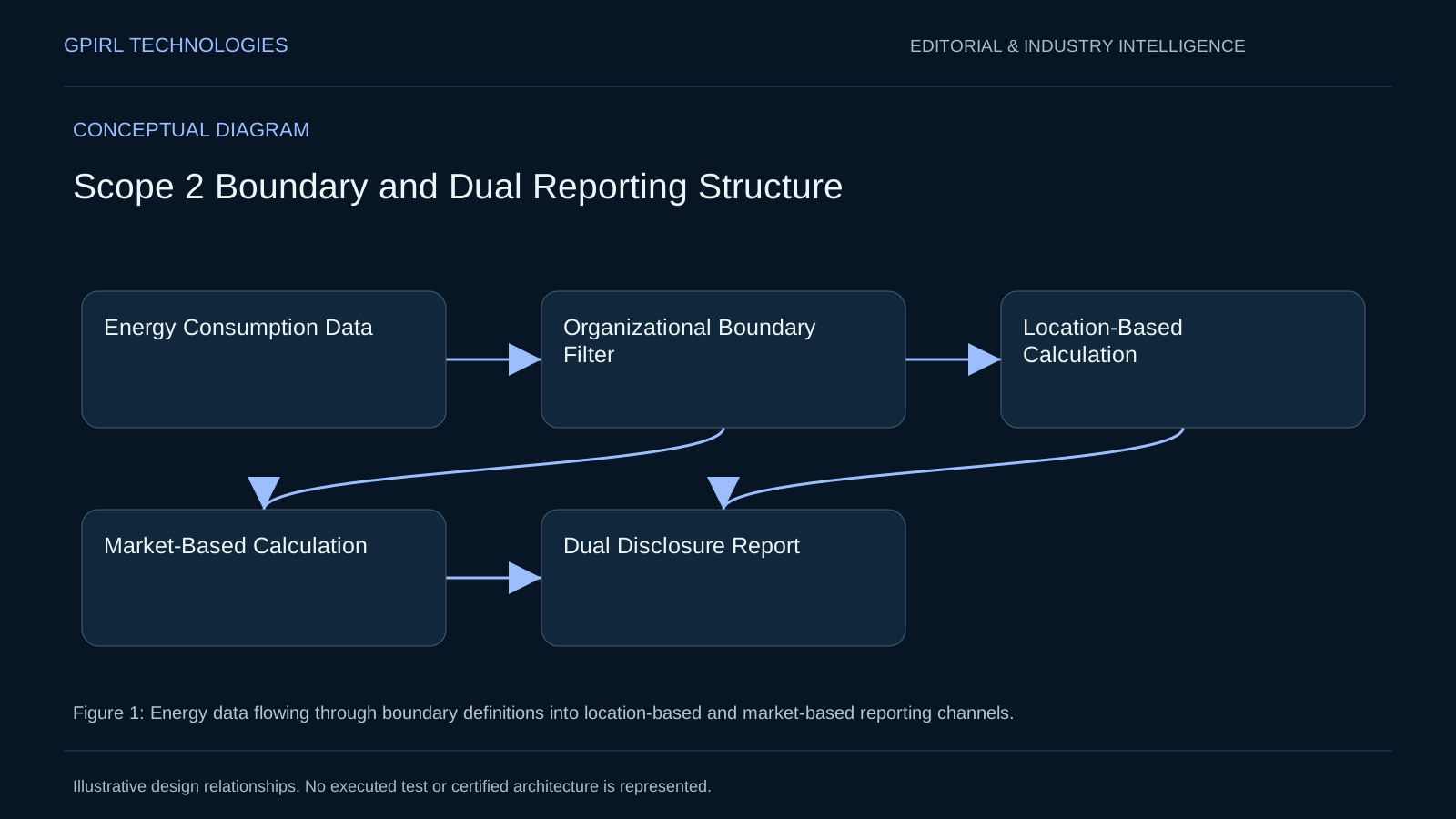
A core requirement of the GHG Protocol Scope 2 Guidance is dual reporting for operations in markets with contractual instruments [S1]. Organizations operating within electricity markets that offer energy attribute certificates, power purchase agreements, or supplier-specific tariffs must disclose Scope 2 emissions using two distinct calculation methods: the location-based method and the market-based method [S1] [S2].
The location-based method calculates emissions using grid average emission factors representing the physical intensity of local grids [S1]. The market-based method quantifies emissions based on contractual instruments acquired by the reporting entity, provided those instruments meet specific Scope 2 Quality Criteria [S1]. Dual reporting presents two accounting perspectives: grid-average factors for consumed energy and eligible contractual attribution. Neither is a direct measurement of the individual electrons consumed.
Contractual Instruments and Emission Claims
A common misconception in corporate reporting is that purchasing energy attribute certificates automatically reduces physical carbon emissions to zero. Under the GHG Protocol Scope 2 Guidance, holding a certificate allows an entity to report a specific market-based emission factor only if the instrument satisfies all defined quality criteria, including unique attribution, cancellation or retirement, and applicable vintage and market-boundary conditions [S1].
Contractual certificates do not alter physical electron flow or imply direct avoided emissions on the local grid. They represent a contractual allocation of attributes within an accounting system [S1]. If contractual instruments fail to meet the required quality criteria, the reporting company must substitute appropriate secondary data, such as residual mix factors or grid average factors, in its market-based calculation [S1].
Synthetic Calculation: Dual Method Comparison
To understand how dual reporting functions, consider a synthetic industrial facility consuming 100 MWh of electricity annually in a regional grid with a location-based emission factor of 0.4 tonnes of CO2 per MWh. Under the location-based method, the facility reports 40 tonnes of CO2 emissions (100 MWh multiplied by 0.4 t/MWh) [S1].
For its market-based report, the enterprise purchases contractual certificates matching the 100 MWh load. If those certificates carry a verified emission factor of 0.1 tonnes of CO2 per MWh, the market-based total is 10 tonnes of CO2. This synthetic illustration shows a clear numerical difference between physical grid intensity and contractual claims. Neither number represents direct physical measurement at the stack; both are calculated outputs derived from established accounting rules [S1].
Failure Investigation: Boundary Mismatches in Reports
Investigating reporting errors often reveals boundary mismatches between financial accounting and operational control. In one hypothetical case, a manufacturing company reports a significant decline in Scope 2 emissions following a corporate restructuring. Audit examination shows that the facility was moved from operational control to a joint venture, removing its emissions from the primary corporate boundary without any change in physical energy use.
This scenario demonstrates why boundary documentation must precede performance claims. Because the disclosure omitted explicit descriptions of boundary adjustments, stakeholders misinterpreted an accounting consolidation change as an operational efficiency improvement. Adhering to GHG Protocol guidance requires reporting structural inventory changes alongside annual emission outputs [S1].
Decision Records: Selecting Consolidation Approaches
The Corporate Standard describes equity-share and control approaches to organizational boundaries, with financial and operational control distinguished [S3]. An operational control boundary includes assets where the company has authority to introduce operating policies, providing plant managers with direct levers for energy reduction. An equity share boundary aligns emissions with economic interest, which may better reflect financial risk.
An architectural decision record for an industrial group might select operational control to align carbon reporting with daily plant engineering oversight. This decision requires documenting every facility under operational management and applying consistent dual-reporting rules across all included sites [S1]. The proposed decision record should explain the chosen boundary and any subsequent changes; consistency does not mean that legitimate structural changes can never require a revised inventory boundary.
Tradeoffs and Limitations of Carbon Accounting Frameworks
Scope 2 accounting methodologies rely on statistical grid averages and market allocations rather than real-time physical packet tracking of electricity. Grid emission factors are updated periodically, introducing temporal lags between operational changes and reported emission updates. Market-based reporting can also create regional imbalances if certificate procurement is decoupled from local grid constraints.
Furthermore, the GHG Protocol provides accounting standards rather than legal compliance guarantees or regulatory opinions [S1]. Corporate teams must separate GHG Protocol reporting from mandatory statutory filings, such as local environmental compliance permits. Relying on Scope 2 market-based zeros without understanding underlying grid realities can expose firms to reputational and regulatory scrutiny.
Practical Implementation Guidelines for Energy Managers
Energy management teams structuring corporate emissions reports should begin by establishing an explicit boundary policy document defining operational control boundaries [S1]. Step two requires gathering verified grid average data for location-based reporting across all operational regions [S1]. Step three involves evaluating all contractual energy instruments against the GHG Protocol Scope 2 Quality Criteria [S1].
Step four executes parallel calculations for both location-based and market-based metrics, documenting all emission factors and certificate retirements [S1] [S2]. Step five publishes both numbers side-by-side with narrative context explaining boundary shifts or procurement changes. Transparent documentation provides a basis for review; accounting accuracy and assurance still depend on the underlying data and applicable requirements.
Proposed Period-to-Period Reconciliation Table
To evaluate how carbon accounting metrics fluctuate over time without conflating numerical updates with physical efficiency changes, sustainability teams can construct a period-to-period reconciliation table. Consider a synthetic example where a facility reports 100 MWh of electricity consumption in two consecutive periods. In the prior period, applying a location-based grid emission factor of 0.4 tonnes of CO2e per MWh yields 40 tonnes of CO2e. In the next period, applying an updated grid factor of 0.3 tonnes of CO2e per MWh yields 30 tonnes of CO2e. The resulting ten-tonne numerical decrease reflects a published factor update rather than an operational energy efficiency gain. Reviewers must record factor versions separately from consumption totals to prevent misleading internal reporting interpretations.
A second row in the synthetic reconciliation table introduces a boundary modification, such as adding a newly acquired subsidiary plant or transferring an existing asset to a joint venture. Comparing these periods directly without examining organizational boundary shifts can make the trend misleading. The review framework requires analysts to keep operational or equity control choices explicit and maintain a rigorous factor version record. Furthermore, the exercise evaluates market-based claims, emphasizing that purchasing contractual certificates does not automatically imply zero emissions: meeting quality criteria makes an instrument eligible for the accounting method, while the applicable factor and allocation still need examination. Participants must explicitly state that no physical avoided emissions are claimed through accounting adjustments alone, separating commercial procurement decisions from direct stack measurements.
The final stage of the reconciliation exercise documents original analytic judgments rather than assuming new mandatory reporting rules. The evaluation records assumed input parameters, identified data gaps, and alternative reporting formats considered by the sustainability group. Reviewers examine unknown outcomes regarding future grid factor revisions and discuss the limitations of relying on static emission estimates for operational decision-making. The resulting decision record explicitly notes that numerical reductions driven by factor updates do not constitute validated energy savings. By structuring the reconciliation table around transparent boundary checks and factor version tracking, organizations maintain defensible carbon inventories while avoiding unsupported claims of environmental impact.
This is an unexecuted design exercise. The assumed inputs support illustration and arithmetic only; no facility measurements, deployed interface results or operational outcomes are reported.
Official background videos
External publisher context. These recordings do not demonstrate GPIRL products or validate the proposed designs.
- GHG Protocol: Scope 2 Recorded Webinar
Official course recording page on the referenced Scope 2 Guidance. Viewing requires a publisher account; the page identifies a free option. No enrolment, payment, certificate or playback is claimed here.
Sources and further reading
- [S1] GHG Protocol Scope 2 Guidance
- [S2] GHG Protocol Scope 2 Guidance PDF
- [S3] GHG Protocol Corporate Accounting and Reporting Standard, Revised Edition
References do not imply product certification or endorsement.
Have a related operational question? Discuss the evidence and review questions in your operating context with GPIRL Technologies.