The Integrity Challenge of Citation Links
Digital reference systems and enterprise research platforms rely on hyperlinked citations to direct readers to supporting primary evidence. However, traditional web links often point to top-level URLs or rely on static HTML element IDs that can be altered during site updates. When a citation link resolves to the top of a lengthy page rather than the specific passage cited, verification efficiency declines.
A common HTML fragment target is an element ID; HTML also defines other fragment-resolution cases [S1]. The WICG Scroll to Text Fragment specification describes an optional user agent feature for navigating directly to text snippets using URL directives [S2]. This document proposes a manual verification protocol for testing citation link accuracy without asserting automated platform testing capabilities.
HTML Fragment Identifiers vs Text Fragments
HTML standards establish that standard fragment identifiers resolve to matching id attributes within the DOM [S1]. When a browser navigates to https://example.org/doc#section2, the user agent scrolls to the element with id="section2" [S1]. A missing fragment target does not itself create an HTTP error. Actual scroll position also depends on navigation history, document loading and browser behavior; it is not universally the top of the page [S1].
The WICG draft specification introduces URL text fragments (#:~:text=start,end), allowing compatible user agents to highlight specific text passages directly [S2]. It is important to note that WICG Community Group Reports represent draft proposals rather than formal W3C Recommendations [S2]. Support for text fragments remains optional and varies across browser implementations.
Navigation Status vs Passage Verification
A fundamental distinction in citation testing is separating HTTP resource availability from passage alignment. An HTTP status code 200 confirms that the web server successfully delivered the requested document page. It does not indicate whether a specific fragment target was located or highlighted within the rendered page [S1] [S2].
If a source publisher edits a document body, removing a cited paragraph, a text fragment link will fail to match target text. A supporting browser may fail to highlight the intended text and may use a valid element-ID fallback if supplied. The resulting scroll position should be observed, not assumed [S2]. The HTTP response remains status 200. Consequently, link verification workflows must evaluate rendered DOM target placement rather than relying strictly on HTTP status codes.
Proposed Citation Alignment Test Procedure
The proposed GPIRL Labs review protocol establishes a manual inspection procedure for verifying reference links. Step one captures the expected source quote, surrounding context snippet, and document version date. Step two constructs the reference URL using standard element IDs or text fragment syntax where supported [S1] [S2].
Step three executes a manual page load in a controlled browser instance. Step four verifies whether the target passage is visible within the initial viewport and properly highlighted. If the user agent does not support text fragments or the passage text has changed, the test outcome is logged as UNKNOWN or MISALIGNED, triggering a manual source re-audit.
Synthetic Case Study: Detecting Citation Divergence
Consider a synthetic research report citing an operational rule: 'The review record identifies its source version.' The citation link is published as https://example.org/spec#:~:text=The%20review%20record. In a proposed Test Run A, suppose that the source page opens, the browser highlights the exact string, and the target text appears centered in the viewport. Under those hypothetical observations, Test Run A would pass passage alignment, without proving the cited claim [S2].
In Test Run B, the source publisher updates the text to read 'The record identifies the version used in review.' Upon loading the link, the browser cannot match the original text string. The test should record whether highlighting failed and where the browser actually navigated; the resource can still return HTTP status 200. Under those assumptions, Test Run B would fail passage alignment because its intended text has changed [S2]. The citation link remains active, but the precise reference target is lost.
Decision Records: Citation Link Structuring
Engineering teams building reference systems must decide how to format external citation links. Relying exclusively on text fragment directives risks link failure when source text undergoes minor wording edits. Relying solely on domain-level URLs requires readers to manually search long documents for backing evidence.
An architectural decision record for a reference platform might specify a fallback linking structure: combining standard HTML element IDs with text fragment parameters (#section-3:~:text=target) [S1] [S2]. If text fragment matching fails, the browser still navigates to the broader section anchor. This decision balances pinpoint quote highlighting with structural navigation resilience.
Tradeoffs, Limitations, and Standards Scope
Implementing deep citation verification involves operational tradeoffs. Maintaining accurate passage links requires monitoring external source updates and refreshing fragment directives when primary texts are revised. For large reference libraries, manual passage verification introduces ongoing maintenance overhead.
Furthermore, verifying that a citation link lands on the correct passage does not prove the underlying statement's truth or accuracy. Link verification validates pointer precision, not source credibility. The proposed protocol provides a testing framework for reference link behavior rather than an automated, guaranteed verification platform.
Practical Implementation Steps for Publishing Teams
Publishing teams managing reference-heavy documents should establish systematic citation link audit routines. Step one mandates storing primary quote snippets alongside full reference URLs in editorial databases. Step two constructs fallback-enabled citation links incorporating element anchors where available [S1].
Step three conducts periodic manual reviews of citation links, checking that target passages load within active viewports [S2]. Step four flags misaligned links for editorial updating when source texts change. These proposed steps can support citation review; failures and unknowns still require an editorial judgement.
Proposed Three-Part Citation Adjudication Record
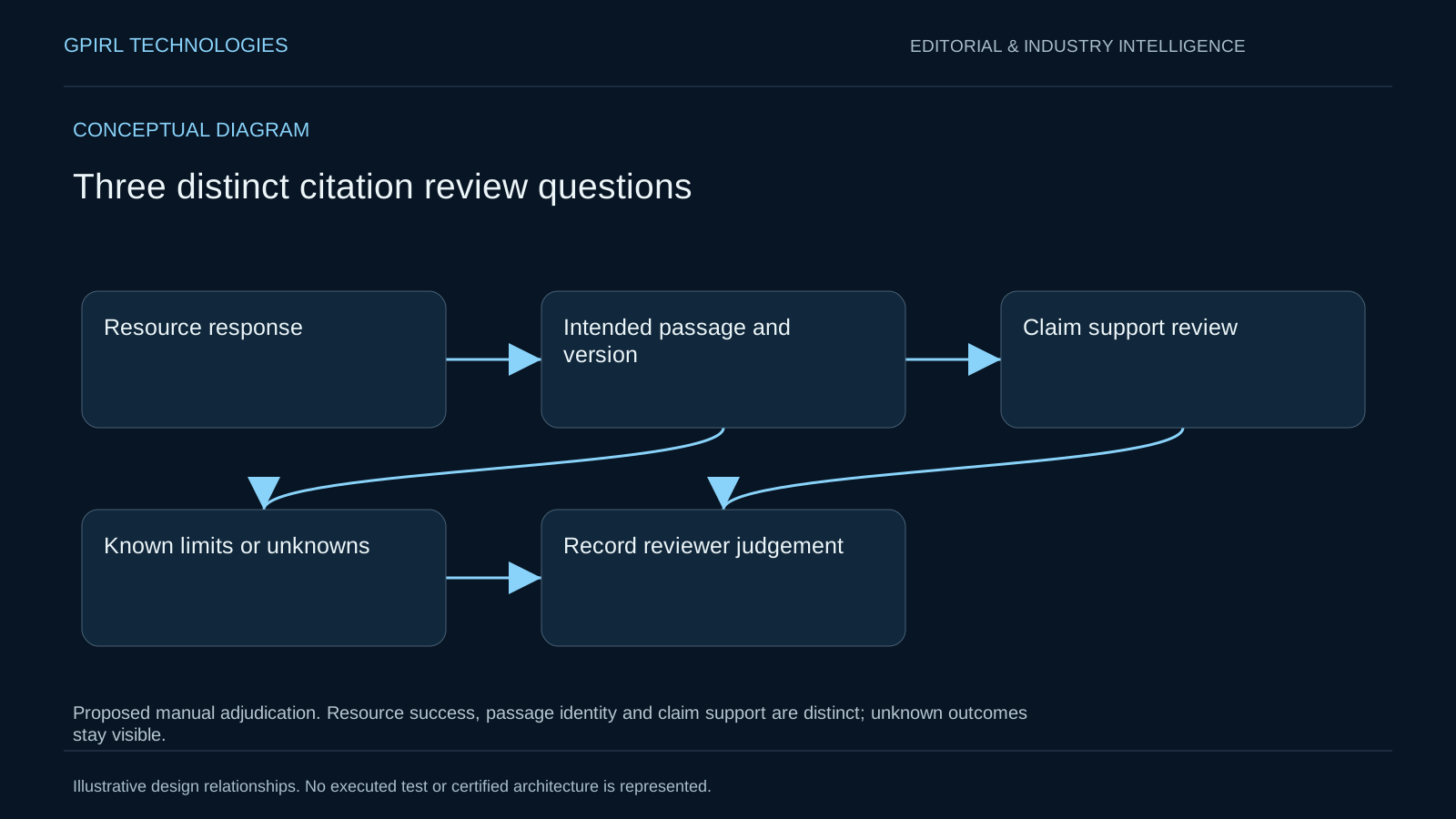
To investigate citation link integrity and verify that reference pointers lead accurately to supporting evidence without assuming automated navigation guarantees, teams can establish a three-part citation adjudication record. Consider two hypothetical verification cases: in the first case, a reference link returns a successful HTTP status code 200, but the target HTML anchor ID has been modified or removed during a site update. In the second case, the link successfully navigates to the correct text passage, but a reviewer discovers that the source text's claim scope was misinterpreted in the citing document. The adjudication framework separates resource fetch success from passage identity and semantic support.
The adjudication process addresses scenarios where a user agent does not support text fragment directives, resulting in an unknown navigation outcome rather than a confirmed broken link. Reviewers acknowledge that WICG draft specifications represent community proposals rather than formal W3C Recommendations, meaning browser support varies widely. The evaluation framework requires human reviewers to compare the cited quote, surrounding document context, and version publication date manually. Furthermore, the record explicitly documents what was not checked, noting limitations such as unverified dynamic content loading or missing archival snapshots.
The proposed review would conclude by compiling assumed input conditions, identified verification ambiguities, and alternative reference tracking strategies without executing automated link scrapers or claiming implemented platform capabilities. Participants record that navigation success does not prove factual truth, emphasizing that link pointers only indicate document locations. The documentation outlines alternative fallback strategies, such as pairing element anchors with descriptive context snippets. By structuring reference audits around a rigorous three-part adjudication record, editorial teams maintain transparent oversight of citation accuracy and identify unwarranted assumptions regarding link stability.
This is an unexecuted design exercise. The assumed inputs support illustration and arithmetic only; no facility measurements, deployed interface results or operational outcomes are reported.
Official background videos
External publisher context. These recordings do not demonstrate GPIRL products or validate the proposed designs.
- W3C WAI: Understandable Content
Official video background on making content understandable. Relevant to the reader-facing meaning review; it does not specify HTML fragment resolution, validate a citation or demonstrate an implemented GPIRL tool.
Sources and further reading
- [S1] WHATWG HTML Living Standard: Scrolling to a fragment
- [S2] WICG Scroll to Text Fragment Draft Community Group Report
References do not imply product certification or endorsement.
Have a related operational question? Discuss the evidence and review questions in your operating context with GPIRL Technologies.