The Ambiguity of Raw Industrial Data Streams
Consider a conceptual manufacturing telemetry review involving measurements such as temperature, vibration, pressure and electrical current. This is a proposed analysis of data interpretation, not an observation about the sensor count, noise level or performance of an operating facility. However, collecting massive volumes of raw sensor data does not automatically translate into operational insight or useful diagnostic clarity. The review would ask whether variation comes from a physical process, measurement conditions, communication or interpretation. A numerical oscillation should not be labelled an equipment fault merely because it appears unusual on a dashboard.
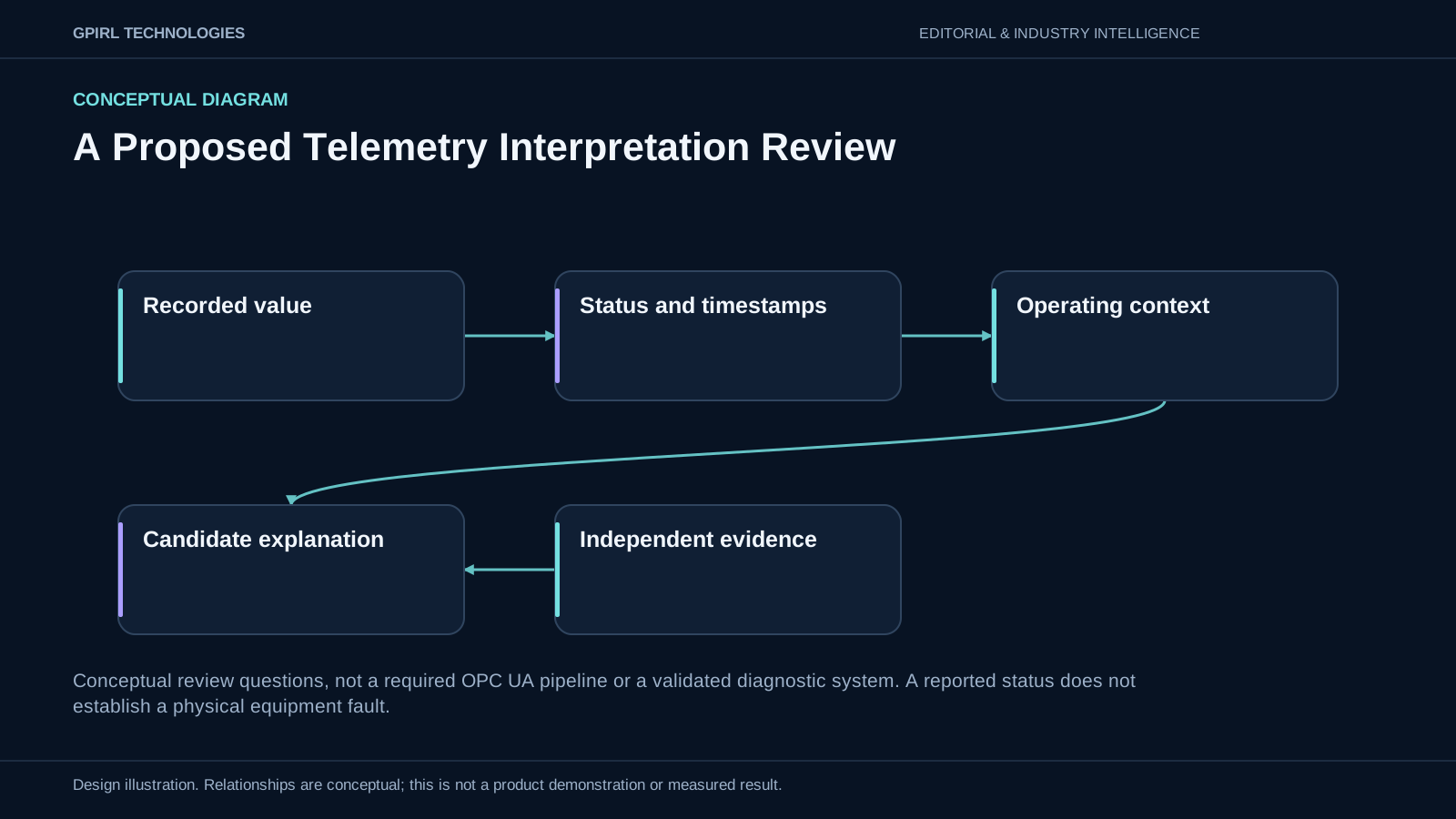
The proposed review would examine measurement context and evidence before interpreting variation as a failure signal. In this proposed review, a threshold crossing is a candidate signal to investigate rather than a diagnosis. The reviewer would ask how the limit was selected, which operating conditions it represents, and what evidence would distinguish an expected variation from an equipment problem. Alert usefulness and the consequences of missed or unnecessary alerts require evidence from the actual application; no alarm-fatigue measurement or failure-prevention outcome is claimed here.
Technical Structure of OPC UA Data Values
To establish reliable data interpretation across industrial networks, standard communication architectures provide structured data types that encapsulate contextual metadata alongside raw numerical values. OPC UA Part4 defines DataValue as a value and associated information, including a statusCode, sourceTimestamp, serverTimestamp and associated precision fields; its value is not restricted to numerical sensor measurements [S1]. Specifically, a DataValue bundles the primary value with a status code, a source timestamp, and a server timestamp. The fields provide context to interpret, rather than proof that a controller physically sampled the process at a particular instant. Implementers should pin the specification edition and review its missing-value and encoding rules before treating this conceptual discussion as an implementation contract.
Separating source timestamps from server reception timestamps is critical for rapid industrial manufacturing lines where network latency or buffer queues can delay message delivery. The checked reference describes sourceTimestamp as the timestamp applied to a Variable value by the data source. ServerTimestamp reflects when the Server received the value or knew it to be accurate. These are not universally an instrument sampling time and a gateway packet-processing time. Their difference alone cannot establish network latency without the relevant clock, update and server behavior assumptions [S1]. Without this temporal precision, downstream analytics engines risk misinterpreting sequential events across complex automated industrial production cells.
Interpreting Status Codes and Managing Quality Flags
In addition to temporal markers, industrial telemetry protocols incorporate explicit status codes that convey the operational validity of every transmitted measurement value. According to foundational automation specifications, the status code describes whether a server can successfully access and provide the requested information [S1]. The DataValue table directs that a value be ignored when its StatusCode indicates an error. This does not make the status a diagnosis of a physical hardware fault or establish that every otherwise accepted measurement is suitable for a maintenance decision [S1].
However, relying solely on basic status flags is insufficient for comprehensive equipment diagnostics. A proposed review should keep reported data usability separate from evidence about calibration and asset condition. Baseline comparisons are one analytical option to assess, not an OPC UA requirement or a guarantee of detecting wear. Reviewers would need independently justified operating conditions, measurement evidence and a way to challenge the interpretation before treating an unusual pattern as a useful failure signal.
Manufacturing Maintenance and Economic Research Context
Understanding the economic and operational necessity of telemetry quality requires examining broader manufacturing maintenance research. NIST AMS100-34, published in2020, examines machinery-maintenance costs and losses in selected US discrete manufacturing, using manufacturer data; its annual estimates refer to2016 [S2]. That economic context motivates questions about maintenance decisions, but it does not prove that a particular telemetry design optimizes repair timing or produces savings. A proposed investment case would need evidence relevant to the asset, intervention and decision being evaluated.
However, transitioning toward targeted maintenance depends heavily on the fidelity of underlying data pipelines. The proposed review would examine how calibration uncertainty, unavailable timestamps and incomplete data affect an interpretation, rather than assume a model necessarily produces a particular error. The NIST report also discusses perceived and observed benefits of maintenance strategies; its scope is not a controlled evaluation of AI telemetry. A contemporary business case needs its own costs, baseline, alternatives and evidence, including evidence that might argue against the proposed investment [S2].
Synthetic Illustration: Managing Stamping Press Telemetry
To illustrate these telemetry principles in practice, consider a synthetic scenario within a heavy metal stamping facility operating large mechanical presses. The proposed, unexecuted scenario would ask how a reviewer could distinguish a vibration change associated with an operating condition from a candidate equipment problem. It supplies no recorded sensor values, alert counts or diagnosed machine condition. Its purpose is to identify what evidence the interpretation would require, rather than prescribe a machine-operating or maintenance procedure.
The proposed analysis might compare vibration, motor current and controller context, provided the relevant measurements and timestamp meanings were independently established. A changed pattern would remain a candidate explanation to investigate. Diagnosing bearing misalignment would require appropriate independent evidence; neither a correlation nor a DataValue status is that evidence. No harness was executed, no technicians received a verified diagnosis, and no diagnostic improvement or loss-free monitoring result is reported.
Architectural Tradeoffs and Operational Constraints
Adopting advanced telemetry processing architectures involves navigating meaningful operational tradeoffs and technical limitations across industrial sites. For the proposed design, reviewers would consider the effort to implement normalization, maintain mappings and keep operating knowledge available. Changes to machinery or software are reasons to reassess those assumptions. The scale of that effort, the actual gaps and the appropriate review method need site-specific evidence rather than an asserted universal cost or assurance of safe resolution.
Furthermore, edge gateways operate under finite storage and power constraints. Edge buffering cannot guarantee zero data loss during extended network outages, because the outcome depends on outage duration, incoming data, retention policy and available storage. Network recovery ordering and power interruptions introduce additional variables that engineers must manage. Organizations must carefully weigh the resource commitments and maintenance overhead of advanced telemetry pipelines against the operational risks of unmanaged data noise, making the proposed tradeoffs among cost, latency and reliability explicit. Neither cited source establishes the performance of this proposed pipeline.
Conclusion on Telemetry Signal Integrity
Industrial telemetry quality remains a foundational requirement for effective operational oversight across manufacturing and energy sectors. For the proposed review, the useful distinction is between a recorded measurement, its reported usability and an explanation of equipment condition. OPC UA supplies relevant DataValue semantics, but neither OPC UA nor an edge-preprocessing layer is a universal architecture requirement or proof of a useful diagnostic signal. Missing measurements and uncertain interpretations should remain visible rather than be filled by assumed context.
Defining useful failure signals requires continuous collaboration between plant floor engineers and data architects, with responsibility for testing interpretations against the relevant physical evidence. This analysis proposes questions for that collaboration, not a completed diagnostic method. Whether a signal changes a maintenance decision usefully remains an empirical question for the actual application; no operational benefit, compliance status or GPIRL implementation is claimed.
Official background videos
External publisher context. These recordings do not demonstrate GPIRL products or validate the proposed designs.
- TheOPCFoundation — What is OPC? UA in a Minute
OPC Foundation introduction provides industrial-interoperability context for the DataValue discussion; it supplies no equipment diagnosis.
Sources and further reading
References do not imply product certification or endorsement.
Have a related operational question? Bring this question to a GPIRL Technologies discovery discussion.