Passkeys and Enterprise Administration
This Deep Dive examines WebAuthn Level 3 using the W3C Recommendation dated 25 August 2026. The specification provides an API for public-key credentials scoped to a relying party [S1]. Administrative console design also raises operational questions about enrollment, loss and the restoration of access. This article separates those questions from the cryptographic ceremony itself. It proposes review exercises for an administrative setting without asserting that a GPIRL console implements the controls, that a particular organization needs one assurance level or that a product has been certified.
WebAuthn's credential scope and origin checks are part of its phishing-resistance model [S1]. They do not settle every question about device loss, sessions or account authority. NIST SP 800-63B-4 provides separate guidance for authentication and authenticator management, including recovery [S2]. The design questions below connect those boundaries in an administrative setting. Recommendations are labelled editorial options; exact requirements need to be interpreted within their stated assurance and implementation scope. An official developer video provides additional background rather than replacing the written protocol and recovery references.
WebAuthn Origin Binding and RP ID Verification
A cornerstone of WebAuthn security is strict origin binding enforced across clients and relying parties. The Relying Party ID is domain-based and omits scheme and port, whereas the origin includes scheme, host, and port. During authentication, the browser or client evaluates credential scope, and the relying party validates expected origins and challenge signatures during transactions. [S1]
Parent-domain RP IDs and Level 3 related-origin requests exist in the specification, so credentials are not strictly restricted to absolute exact-domain isolation in all configurations. Relying parties must implement origin validation rules to ensure unexpected origins are rejected, while recognizing that origin checks are performed by client software and validated by relying parties rather than being handled exclusively by authenticator hardware. [S1]
Authenticator Models and Syncable Credentials
WebAuthn uses public-key credentials created and managed through authenticators. The relying party retains the public key used to verify an assertion [S1]. A credential's handling and backup properties need to be inspected in the chosen implementation. Some credentials can be backed up or synchronized; the article does not assume that every private key remains in one hardware enclave or that all synchronization arrangements are equivalent. A review should document the actual storage and restoration dependencies before drawing an assurance conclusion from a product label.
For an administrative design, this article proposes recording the selected credential model and its recovery dependencies. A device-bound credential and a syncable credential can leave different questions about device loss, account access and backup. The review should identify those dependencies in the chosen implementation rather than declare one universally preferable. Having two credentials does not automatically create independent recovery paths if both depend on the same account or device. The relevant question is which failure the proposed backup actually addresses.
Administrative Enrollment and High-Assurance Onboarding
WebAuthn registration establishes a credential relationship with a relying party; it does not, by itself, decide which human should receive an administrative role. NIST SP 800-63B-4 concerns authentication and authenticator management, including binding and recovery [S2]. Initial identity proofing and the application's assignment of authority require their own accepted processes. The proposed enrollment review should therefore identify who may request a credential, how that request is accepted and which existing authority permits the binding. This article does not infer those decisions from successful cryptographic registration.
As an editorial option, an organization could require an additional approval for selected administrative bindings and independently notify the account holder. The choice depends on the accepted assurance and operating requirements; WebAuthn does not mandate the same approval ceremony for every console. A proposed test would include an unexpected enrollment request and an unavailable approver, with the expected handling agreed in advance. It would record whether an alternative credential can be used without silently granting a new party authority to enroll one.
Authenticator Loss and Failure Scenarios
Physical passkey authenticators are vulnerable to loss, theft, hardware failure, or employee turnover. When an administrator loses their sole hardware passkey, they face potential lockout from the enterprise console. Without a pre-established, secure recovery policy, the organization is left without a viable mechanism to restore access securely.
A recovery process should be reviewed as an alternate path into the account. In the proposed administrative exercise, a helpdesk request alone would not be treated as proof that the requester owns the account. Reviewers would identify which evidence the accepted process requires, who may approve restoration and how the subscriber is notified. These are design questions for the selected organization. The article reports no tested resistance to social engineering and does not claim that a checklist makes an implementation immune to impersonation or fraud.
Designing an Administrative Recovery Policy
One editorial option is to enroll a backup credential before the primary path is lost. The proposed review would ask whether that credential can be reached when the primary device or account is unavailable, who can use it and how its continued validity is checked. A physical backup and a synced credential may have different dependencies. This article does not mandate a vault, two security officers or one credential count for every administrator. The accepted assurance context should guide the selected arrangement and its tests.
The desired property of the proposed recovery policy is a defined way to restore an accepted subscriber's access without treating missing evidence as approval. That requires a decision about what to do when the available recovery path cannot establish the required assurance. A temporary loss of administrative convenience may be the appropriate outcome for that workflow. The policy should state the operating fallback and its owner, rather than promise that any recovery mechanism can simultaneously preserve access and resolve every security concern.
Out-of-Band Verification and Recovery Governance
NIST SP 800-63B-4 Section 4.2 distinguishes account recovery from ordinary authentication and describes methods and requirements according to assurance context. Recovery also causes subscriber notification under that guidance [S2]. An organization referring to it needs to identify the applicable IAL and AAL conditions; the article does not assign those levels. The proposed administrative record would distinguish a recovery after loss of required authenticators from binding an additional credential while the subscriber can still authenticate through an accepted existing path.
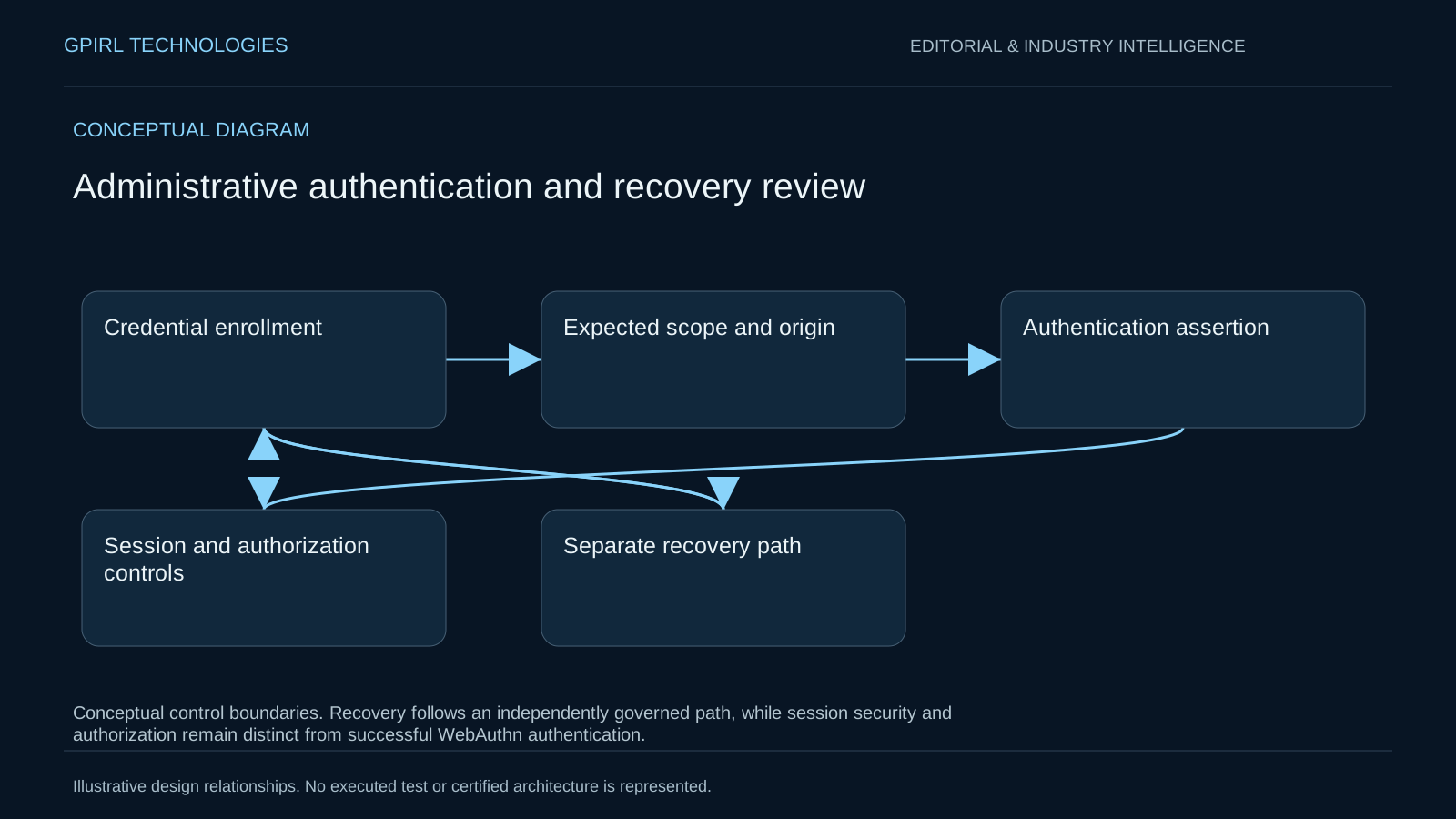
A proposed recovery audit record could retain the request, the accepted evidence references, the decision authority and the resulting credential changes, with detail appropriate to the organization's information handling rules. This is an editorial option, not a claim that WebAuthn mandates one log schema or establishes regulatory compliance. Session security and authorization also remain separate concerns after authentication succeeds. A recovered credential should not be assumed to resolve a compromised session, an inappropriate administrative role or an external action that occurred before recovery.
Conclusion on Passkeys and Recovery Governance
Origin validation and public-key authentication should be assessed within the implementation's stated scope. The administrative design also needs an accepted response to authenticator loss: that may involve recovery, another previously bound credential or an operating fallback when the required evidence cannot be established. The selected choice should be explicit and tested in its own context. This article's hypothetical exercises do not establish that an implementation resists every phishing attempt or that a recovery arrangement meets an organization's assurance requirements.
The review should end with the boundaries that remain open. Credential scope can be correctly configured while a recovery process accepts inadequate evidence. A recovery can be legitimate while an active session still needs investigation. An administrator can authenticate successfully while lacking authority for a particular action. This article's proposed approach keeps those outcomes separately visible. It offers a structured set of questions and primary references, not proof of a completed security assessment, a compliant deployment or a universal recovery architecture.
A proposed loss and recovery exercise
For an unexecuted exercise, consider an administrator who loses access to the primary device while a separate administrative session remains open elsewhere. The review would distinguish the missing authenticator, the remaining session and any alternative credential already bound to the account. It would ask which accepted path can establish the subscriber's identity at the required assurance and who may authorize subsequent changes. The presence of an open session would not automatically answer every enrollment or recovery question. Expected decisions should be agreed before testing, including the circumstances under which restoration must remain unresolved.
A second proposed case would remove access to the account used to synchronize a credential. Reviewers would examine whether the intended backup depends on that same account and whether its restoration follows a separate accepted process. A third case would present an unexpected recovery notification to the legitimate subscriber. The exercise would inspect where that report goes and who investigates it, without claiming that the notification itself prevents misuse. These cases are hypothetical review inputs, not reported incidents or measured defenses. They connect the chosen recovery policy to concrete failure conditions while leaving protocol and operational authority as distinct controls.
Official background videos
External publisher context. These recordings do not demonstrate GPIRL products or validate the proposed designs.
- Modernize authentication with passkeys, digital credentials, and more
Official Google I/O 2026 background on modern authentication. Exact RP ID/origin and recovery requirements remain grounded in WebAuthn and NIST. No GPIRL implementation or endorsement is implied.
Sources and further reading
- [S1] W3C WebAuthn Level 3 Recommendation, 25 August 2026
- [S2] NIST SP 800-63B-4: Authentication and Authenticator Management
References do not imply product certification or endorsement.
Have a related operational question? Review one administrative enrollment and recovery path against the evidence described in the article.