Introduction to Payroll Correction Contracts
Modern enterprise architectures frequently rely on event-driven patterns to decouple core human resources systems from downstream payroll calculation engines, ledger postings, and benefits administration platforms. Event streaming can carry hours and payroll-status messages, while the business systems perform the actual payment and recordkeeping functions; handling corrections, reversals, and restatements introduces deep architectural challenges. When a retroactive wage adjustment, erroneous deduction, or hours correction occurs, downstream systems cannot simply ingest a duplicate or amended payload without a tightly disciplined event contract. Without clear contractual boundaries separating generic transport metadata from domain-specific business data, consuming services risk applying conflicting adjustments, corrupting historical general ledgers, or failing to maintain auditable wage tracks.
This engineering analysis examines a proposed event contract tailored for payroll correction events, establishing a rigorous separation between the standardized event envelope and custom business-level payload attributes. By anchoring our design in established interoperability standards while explicitly acknowledging their technical boundaries, we can build robust recovery sequences. It is vital to state clearly from the outset that no event envelope design, message broker configuration, or schema definition can unilaterally guarantee storage immutability, legal compliance, cryptographic audit trails, or strict delivery sequencing on its own. Storage configuration, producer/consumer behavior and institutional controls must be evaluated together; even that combined design requires evidence and cannot promise every operational or legal outcome.
To explore these mechanics thoroughly, this paper breaks down the architectural anatomy of correction events in the following sections. We examine the mandatory core attributes required for baseline event routing, evaluate how business-specific correlation identifiers manage multi-step corrections, walk through a concrete synthetic reversal sequence step-by-step, analyze the inherent tradeoffs between identifiers and processing order, and review external compliance reference points without overstating what streaming middleware can achieve. By focusing on deterministic data flows and clear contractual contracts, engineering teams can design payroll correction pipelines whose failure assumptions and unresolved responsibilities can be examined.
Distinguishing the Standard Event Envelope from Business Payload
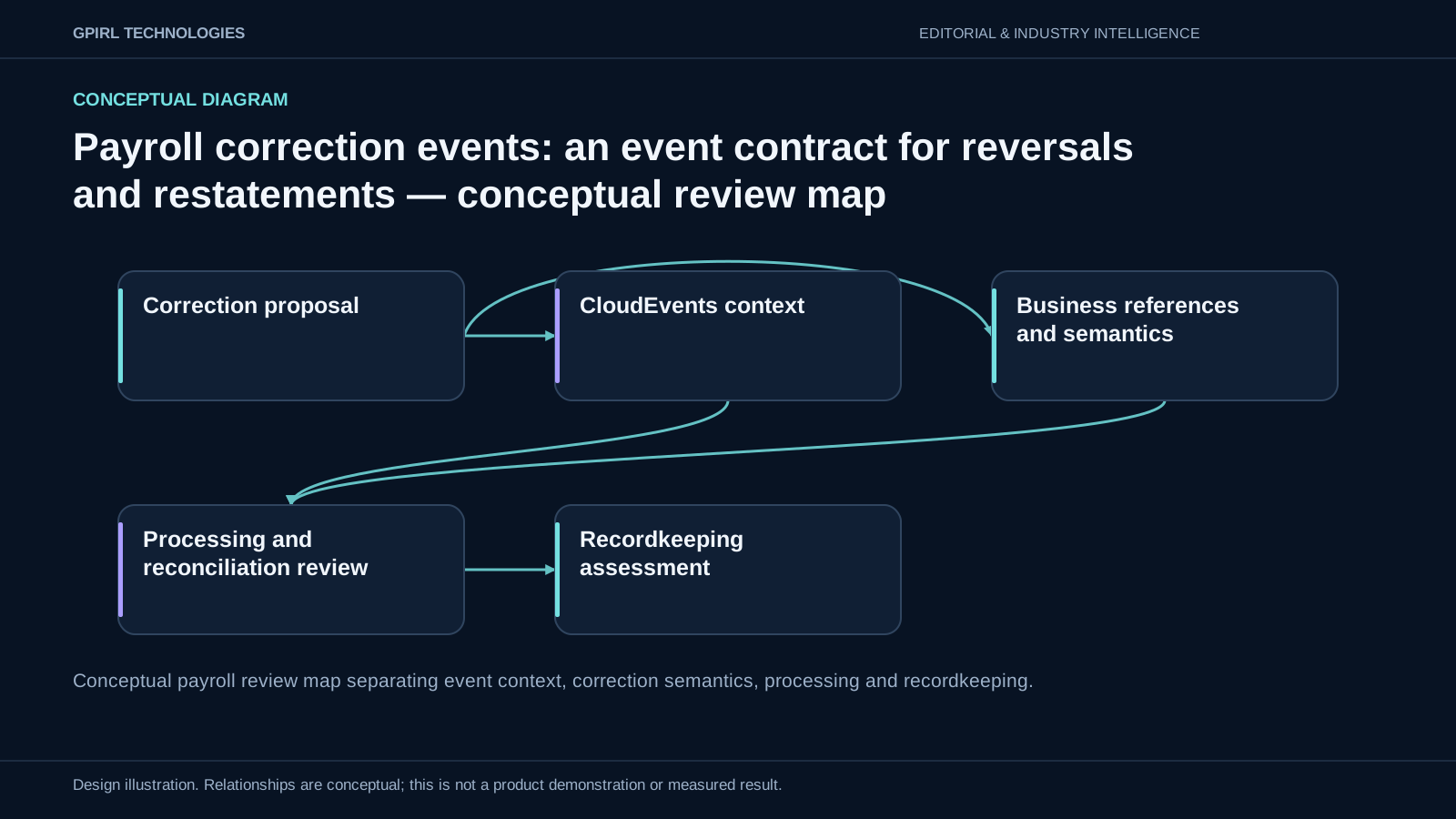
A foundational principle in distributed event design is the clean separation of routing infrastructure from domain-specific application data. The CloudEvents specification provides a stable, vendor-neutral baseline for describing event data in a common format. According to the specification, core context attributes such as 'id', 'source', 'specversion', and 'type' are mandatory for baseline interoperability. The serialized specversion value for this patch release is strictly defined as 1.0. Producers must ensure that the combination of 'source' plus 'id' remains unique for each distinct event, allowing consumers and brokers to identify duplicates effectively. Furthermore, while an event may optionally include a 'time' attribute expressed as an RFC3339 timestamp, when occurrence time cannot be determined, a producer may use an alternative time, but producers for the same source must use a consistent algorithm [S1].
Critically, these core attributes only provide the routing envelope. Additional context attributes are fully permissible within the specification, but their domain-specific meaning resides entirely outside the core standard. CloudEvents does not itself specify payroll approval workflows, consumer-side side effects, tax calculations, or multi-system reconciliation. In our proposed payroll correction contract, we strictly isolate standard envelope fields from custom business payloads. The envelope carries context that bindings, routers and consumers can use. Its specversion identifies CloudEvents, while the payroll business-schema version needs its own definition. The payload carries sensitive enterprise context such as employee identifiers, tax jurisdiction codes, pay period boundaries, and adjustment categories. Mixing these layers creates tight coupling, complicates schema evolution, and makes it difficult for generic message routers to process envelopes without inspecting proprietary business semantics. [S1]
When engineering payroll pipelines, teams often make the mistake of overloading the event envelope with custom business flags or authorization states. For this proposed design, keeping sensitive or complex business data in the payload can simplify separation of concerns. Domain-specific extensions are nevertheless permitted by CloudEvents and can be useful for filtering when their meaning and privacy implications are defined [S1]. By keeping the envelope minimal and pushing all domain logic into a structured data payload, downstream consumers can evaluate routing criteria using standard HTTP-like headers or broker filter expressions without unmarshalling heavy payroll records. This proposed boundary may reduce coupling, but compatibility still depends on consumers, bindings and schema-change behavior; a separation rule is not proof of stable delivery.
Proposed Business-Specific Fields and Correlation Architecture
While standard event envelopes dictate how an event travels through a message bus, payroll correction workflows require an explicit set of business-specific fields to manage lifecycle states safely. In our proposed extension to the event contract, we introduce explicit domain attributes within the data payload: 'correction_type', 'original_event_id', 'effective_pay_period', 'adjustment_amount', and 'correlation_chain_id'. These fields bridge the gap between abstract event routing and concrete financial adjustments. The 'correction_type' attribute categorizes the modification—such as an hourly rate correction, missed overtime addition, or deduction reversal—allowing downstream consumers to branch their processing logic immediately upon ingestion.
The 'correlation_chain_id' is particularly vital for multi-step restatements. In many enterprise scenarios, a single payroll error discovered during an audit may trigger a cascade of adjustments across multiple pay cycles, tax jurisdictions, and benefit contributions. By assigning a shared correlation chain identifier across all related events, monitoring tools can link related records if the relevant events were captured. A correlation key alone does not prove complete lineage, prevent orphaned records or determine whether a compensating action is correct. It is important to emphasize that this correlation structure is a custom design proposal for enterprise payroll domains and is not mandated, validated, or interpreted by base event specification standards.
Managing these business-specific fields requires strict adherence to schema versioning and backward compatibility. If a payroll system introduces a new adjustment classification, consumer applications must be capable of handling unrecognized or legacy codes gracefully without throwing unhandled exceptions that could stall entire partitions. Optional extension dictionaries and explicit enumerations are design options, but an unknown-value policy, compatibility tests and versioned consumer expectations remain necessary to assess a change.
Synthetic Reversal and Correction Sequence
To understand how these contractual elements interact in practice, let us examine a synthetic payroll correction sequence. Consider employee Jane Doe, whose regular hours for the pay period ending October 15 were incorrectly reported as 35 hours instead of 40 hours due to a time-tracking system synchronization delay. The initial payroll run generated a standard disbursement event with identifier 'evt_pay_88392' from source '/hr/time-tracking'. Downstream ledger and banking services consumed this event and executed the direct deposit.
Upon discovering the discrepancy, the payroll corrections service issues a formal correction event. Rather than mutating the past event or issuing an ambiguous adjustment, the producer emits a structured reversal-and-restatement sequence. First, it publishes a reversal event: event ID 'evt_rev_99101', type 'com.enterprise.payroll.v1.reversal', referencing 'original_event_id': 'evt_pay_88392', with a reversal payload of -35 previously recorded hours. Under the proposed dependency rule, it then emits a restatement event: event ID 'evt_cor_99102', type 'com.enterprise.payroll.v1.restatement', carrying the corrected total of 40 hours under the same 'correlation_chain_id': 'chain_xyz_778'. Both events share the same source and maintain unique IDs as required by event specifications.
Downstream consumers processing this sequence apply idempotency checks using the source and event ID combination. When the ledger service receives 'evt_rev_99101', it verifies whether that specific correction ID has already been processed. If not, the illustrative hours-ledger operation reverses the original 35-hour entry, then the restatement records 40 hours: 35 - 35 + 40 = 40. A delta-only design would instead add five hours and must not also post the full replacement. Rates, gross/net pay, tax adjustments and any recovery of a bank payment are outside this hours-only example. Upon receiving 'evt_cor_99102', it posts the correct full-period valuation. If network congestion or broker retries cause 'evt_cor_99102' to arrive before the reversal, robust consumer state machines hold or buffer the restatement until the preceding sequence marker is resolved, or reject out-of-order mutations to prevent temporary ledger corruption. This is an unexecuted hours-ledger design example. It illustrates questions to test, not an actual payment, a statutory reversal procedure or demonstrated financial accuracy.
Identifier, Business Correlation, and Processing Order Tradeoffs
Architecting a high-throughput event pipeline involves navigating complex tradeoffs between event identifiers, business correlation mechanisms, and processing order guarantees. At the infrastructure level, message brokers rely on simple keys or partition identifiers to order messages. However, strict global ordering across an entire enterprise event mesh is notoriously difficult and usually comes at the severe expense of horizontal scalability and throughput. Engineering teams must decide whether to partition payroll events by employee ID, pay period, or source system. Partitioning by employee ID can group related messages, but source production order, retries and broker/consumer behavior determine the observed order; it does not establish event-time chronology, but it can create partition hot spots during company-wide year-end payroll restatements.
Conversely, separating technical message identifiers from business correlation keys introduces architectural complexity. A CloudEvents source-plus-id pair supports duplicate identification; the specification does not prevent repeat delivery or make a business operation idempotent [S1]. However, transport deduplication is completely blind to business logic; a resent duplicate may retain the same source-plus-id pair, while a distinct second correction needs a distinct pair even when it affects the same pay cycle [S1]. Therefore, relying solely on transport-level IDs is insufficient for business-level reconciliation. Consumers must implement secondary domain-level idempotency stores that check business keys like employee ID combined with pay period and adjustment sequence numbers.
Another critical tradeoff lies in asynchronous event eventual consistency versus synchronous ledger synchronization. While event-driven architectures excel at decoupling producers from consumers, payroll corrections demand high determinism. If an event consumer processes a correction out of order—such as applying a restatement before a reversal—the resulting account balances can become temporarily or permanently invalid depending on the idempotency design. Architects must weigh the latency benefits of asynchronous event streaming against the absolute necessity of transactional correctness in financial workflows, often introducing compensating reconciliation jobs to catch and repair ordering anomalies that slip past real-time filters.
External Compliance Reference Points and Operational Boundaries
When designing payroll systems and event contracts, engineers must remain cognizant of legal and regulatory recordkeeping frameworks, such as those enforced by regulatory bodies like the United States Department of Labor (DOL). For covered and non-exempt worker records, DOL Fact Sheet 21 outlines required identifying information, hours worked, wage rates, and total earnings, requiring accurate information without prescribing one specific technological format, database engine, or software architecture. Furthermore, the fact sheet distinguishes between payroll records that must be retained for at least three years and supporting wage-computation records—such as time cards or piecework tickets—that must be retained for two years. [S2]
It is imperative to maintain architectural humility regarding what event contracts and messaging middleware can achieve in this context. An event envelope, schema registry, or message broker does not constitute a legal recordkeeping system, a cryptographic audit trail, or a compliance guarantee. The cited DOL fact sheet requires records and retention within its US FLSA scope; it does not mandate cryptography, append-only storage or a particular tamper-evident technology [S2]. Event streams are transient transportation fabrics designed for moving state changes between systems; retained broker logs have configurable retention, which must be assessed against the actual recordkeeping purpose and obligations. Whether a streaming platform can form part of the record system depends on its configured retention, retrieval, completeness and applicable obligations; it is not categorically prohibited by this fact sheet.
For this proposal, the team should identify which configured record system meets the relevant retention and retrieval requirements; an object store, database or other suitable approach may be assessed. The cited fact sheet does not require an immutable storage architecture [S2]. The event contract serves strictly as the transactional wire protocol that communicates corrections between operational microservices. By establishing a clear division between real-time event transmission and long-term regulatory storage, organizations can build flexible, high-performance integration layers while documenting the limits of the design and obtaining a separate assessment of applicable recordkeeping duties.
Official background videos
External publisher context. These recordings do not demonstrate GPIRL products or validate the proposed designs.
- CNCF [Cloud Native Computing Foundation] — Deep Dive: CNCF Serverless WG/CloudEvents - Clemens Vasters & Vlad Ionescu
Event-description and interoperability background relevant to the proposed correction-event contract, with release and payroll-domain limits explicit.
Sources and further reading
References do not imply product certification or endorsement.
Have a related operational question? Bring this question to a GPIRL Technologies discovery discussion.