The Technical Complexity of Payroll Decimal Math
Payroll calculation is perceived by non-engineers as arithmetic: multiplying hours worked by an hourly rate, applying deductions, and disbursing net pay. In practice, payroll engineering is a precision computational discipline where rounding discrepancies can introduce reconciliation drift and audit questions across pay cycles. A team whose rounding choices exist only in runtime defaults has an avoidable review question: where is the intended arithmetic policy recorded? This article argues for documenting that choice; it does not assert how commonly payroll products omit it.
When applications perform currency calculations using binary floating-point representations (such as IEEE 754 binary floats), fractional decimal amounts like 0.1 or 0.05 cannot be represented precisely. Representation differences can affect calculations or equality comparisons; their practical effect depends on the calculation, precision and rounding stages rather than an inevitable payroll discrepancy. Over thousands of employee records processed weekly, fractional discrepancies can accumulate into variances that complicate general ledger reconciliation.
Establishing a documented decimal policy is an architectural consideration for software reliability. According to official Python decimal module documentation, decimal floating-point arithmetic modules are designed to emulate base-10 decimal math, avoiding binary floating-point limitations by operating on base-10 representations with configurable precision and rounding contexts [S1]. This editorial argument explores why payroll systems benefit from explicit decimal policies governing rounding modes, tie-breaking rules, and calculation stages.
Floating-Point Pitfalls and Decimal Floating-Point Representation
A pitfall in financial software engineering is the use of standard binary floating-point data types (such as double or float in languages like Java, C++, or JavaScript) for currency calculations. Binary floating-point arithmetic operates on base-2 fractions, making exact representation of base-10 decimal fractions impossible for values that do not sum to powers of two. For example, adding 0.1 and 0.2 in a standard binary float yields 0.30000000000000004 rather than 0.3.
In payroll systems, where calculations involve fractional wage rates, overtime multipliers, and tiered percentage deductions, binary float inaccuracies can compound across calculation pipelines. A payroll engine processing earnings across weekly pay periods using binary floats can introduce sub-cent cumulative errors that manifest as discrepancies between payslip breakdowns and disbursement files. Addressing these factors involves adopting decimal floating-point representations.
Decimal representation can preserve intended decimal inputs, but finite precision still rounds operations such as division. Constructing Decimal from a binary float preserves that float's exact approximation, not the original decimal intent. Strings, integers or another explicit input policy avoid that particular ambiguity [S1]. Integer minor units can also be suitable when their scale and operations are defined. However, even when using decimal data types, developers define how intermediate and final results are rounded. Without a documented decimal policy governing precision limits, developers working on separate microservices within a payroll platform can implement inconsistent rounding behaviors, leading to calculation drift.
Analyzing Rounding Modes and Positive-Negative Ties
When a decimal calculation results in a fractional value extending beyond two decimal places (such as 1.225 or 1.235), systems apply a rounding mode to adjust the value to currency precision. According to the IBM General Decimal Arithmetic specification, standardized rounding algorithms exist, including ROUND_HALF_UP, ROUND_HALF_DOWN, ROUND_HALF_EVEN, ROUND_FLOOR, and ROUND_CEILING [S2]. Each mode distributes rounding adjustments differently across datasets.
The choice of rounding mode is a design decision in payroll engineering. For instance, 'round half up' (where ties round away from zero, so 1.225 rounds to 1.23) moves a positive halfway value upward. Conversely, 'round half even' (banker's rounding), which rounds ties toward the nearest even digit (so 1.225 rounds to 1.22), chooses the nearest even retained digit at a tie. Its aggregate effect depends on the distribution of actual inputs, so it does not guarantee zero bias for every payroll dataset.
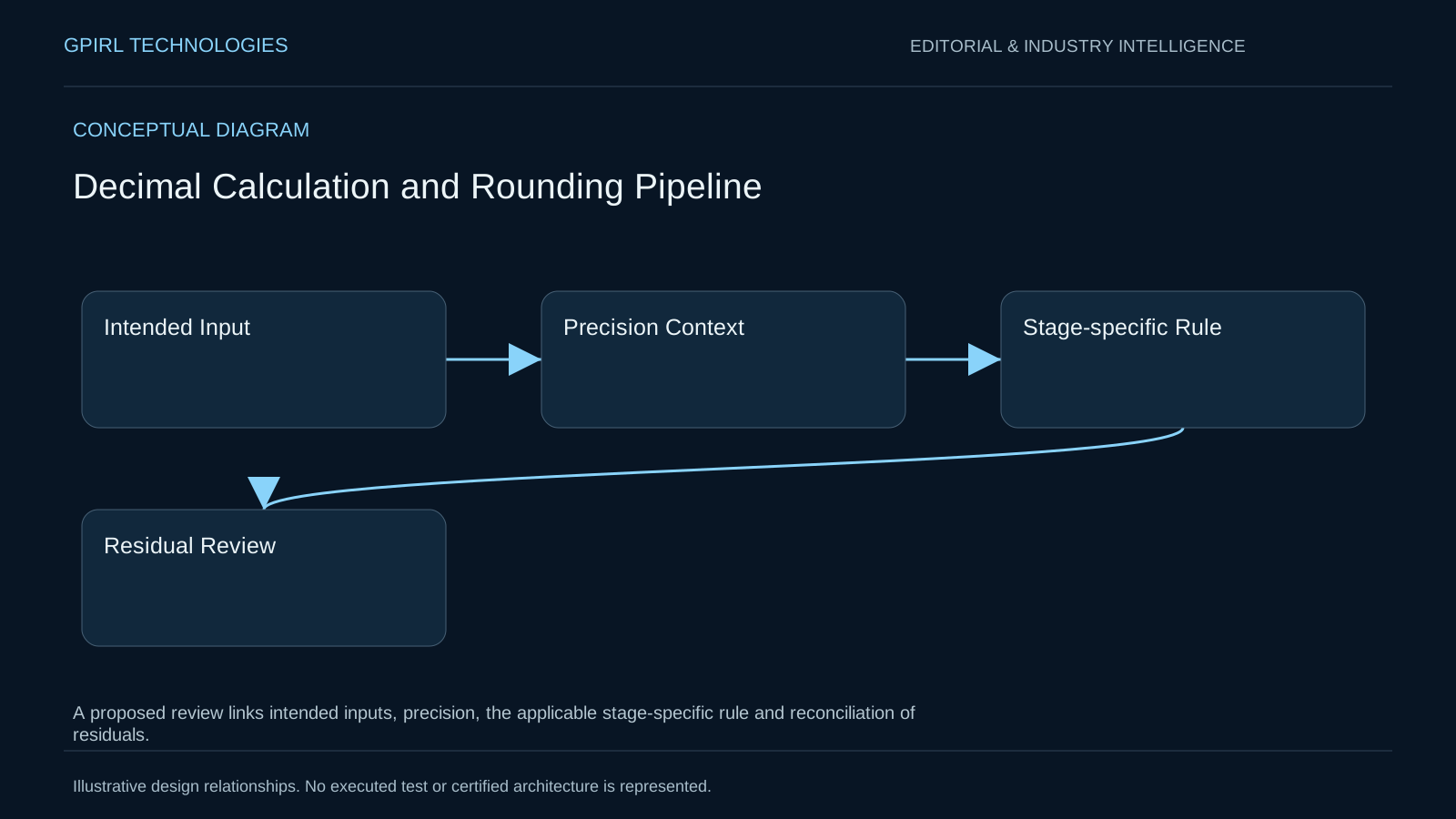
To illustrate positive and negative tie handling when rounding to two decimal places: for the value 1.225, ROUND_HALF_UP yields 1.23, while ROUND_HALF_EVEN yields 1.22. For the negative value -1.225, ROUND_HALF_UP yields -1.23 (away from zero), while ROUND_HALF_EVEN yields -1.22 (toward nearest even). FLOOR rounds toward negative infinity, whereas DOWN rounds toward zero, producing distinct results for negative numbers. A policy should map each calculation stage to its applicable rule and version. Different stages can legitimately use different rules; consistency means executing the documented choices.
Stage of Rounding: Intermediate Versus Final Outputs
A source of payroll reconciliation errors is the premature rounding of intermediate calculation steps. In complex compensation structures involving hourly rates, overtime multipliers, and proportional deductions, calculations pass through multiple transformation stages. If a system rounds intermediate figures to two decimal places at every step, cumulative rounding error can become magnified, distorting final net pay calculations.
A decimal policy can dictate that intermediate calculations be performed at configured precision, with rounding applied at the final output stage—such as when generating payslip line items or bank disbursement files. That is one possible staging policy to evaluate, not a universal recommendation. Currency scale, statutory formulas, line-item reporting and settlement interfaces can require other explicitly documented rounding points.
Nevertheless, statutory tax tables or regulatory deduction formulas can mandate intermediate rounding at specific legislative calculation steps. A documented decimal policy outlines where intermediate rounding is required and where high-precision retention is maintained until final output generation.
Hypothetical Tabletop Scenario: Arithmetic Rounding Exercise
To examine rounding behaviors without relying on large-scale simulations or unverified outcomes, consider a hypothetical arithmetic tabletop exercise involving a small sample of employee earnings. The proposed worksheet uses two abstract amounts, 1.225 and 1.225, with an illustrative two-decimal output scale. They are arithmetic fixtures, not worker pay or a statutory rule.
With HALF_UP, rounding each fixture first gives 1.23 + 1.23 = 2.46; summing first and then rounding gives 2.45. HALF_EVEN rounds each 1.225 to 1.22, giving 2.44, while the aggregate remains 2.45. Neither mode removes the difference between rounding stages. The review question is how the applicable domain rule assigns and explains any residual, rather than which mode promises to eliminate it.
This hypothetical tabletop exercise illustrates how documenting and testing rounding policies in a controlled setting helps engineering teams understand cumulative arithmetic effects before deploying payroll logic to production environments.
Reconciliation Challenges and Residual Allocation Policies
Reconciliation is a test of payroll system integrity. At the conclusion of a pay cycle, gross earnings minus deductions and taxes must equal net disbursement, and employee payslips reconcile with general ledger summaries. When cumulative decimal drift occurs due to unmanaged rounding, finance teams may rely on manual reconciliation overrides, introducing operational friction.
A documented decimal policy mitigates reconciliation drift by establishing predictable, mathematically rigorous boundaries. When accountants and auditors review payroll software architecture, a clear decimal policy demonstrates that calculation outcomes are governed by documented arithmetic standards.
Furthermore, reconciliation mechanisms can be automated within payroll pipelines. Monitoring tools can verify that the sum of individual employee net payments matches aggregate funding accounts down to the cent, alerting finance operations if cumulative drift exceeds acceptable tolerances.
Distinguishing Payroll Rounding from Legal Compliance
It is important to distinguish payroll decimal rounding policies from legal and tax compliance rules. A decimal rounding policy is an internal technical standard governing software precision, arithmetic modes, and stage of rounding. It does not constitute legal or tax advice, nor does it override statutory payroll regulations mandated by government tax authorities or labor departments.
Different jurisdictions enforce distinct statutory rules regarding how fractional cents in tax withholdings or minimum wage calculations must be handled. No jurisdictional rounding requirement is asserted here; an implementation needs the applicable primary rule and specialist review. An enterprise decimal policy operates within the boundaries of local statutory requirements without claiming that software rounding rules guarantee legal compliance.
Engineering teams can collaborate with legal and payroll compliance experts to ensure technical rounding configurations align with regional statutory mandates, while maintaining internal mathematical consistency across operations.
Opinionated Decision Checklist for Decimal Policies
To establish a documented decimal policy for payroll and financial software systems, engineering and finance leadership can utilize a decision checklist:
1. Representation Choice: Is the chosen decimal or integer-scale representation appropriate for the operations, inputs and output interface?
2. Standardized Rounding Mode: Is a specific rounding mode (such as ROUND_HALF_EVEN or ROUND_HALF_UP) documented across system modules?
3. Calculation Staging: Are intermediate calculation steps executed at extended precision, restricting rounding to final output generation where appropriate?
4. Tie-Breaking Documentation: Are positive and negative tie-breaking rules tested and documented for financial amounts?
5. Automated Reconciliation: Are automated checks implemented to verify that individual paystub totals reconcile with aggregate general ledger summaries?
6. Statutory Alignment: Are internal rounding policies reviewed against regional labor and tax authority regulations?
Limitations, Assumptions, and Operational Boundaries
It is essential to acknowledge the limitations and assumptions inherent in editorial recommendations regarding payroll decimal policies. While adopting decimal floating-point arithmetic and formal rounding modes helps manage precision, it does not eliminate human error in initial data entry, such as incorrect hourly wage inputs or tax table configurations.
Furthermore, editorial arguments and policy frameworks are proposed best practices for software engineering and financial system design; they do not represent universal legal rules or accounting standards. Each enterprise tailors its decimal policy to its operational jurisdictions, software tech stack, and financial risk tolerance.
Treating payroll rounding as an engineering policy makes assumptions available for review. Whether a proposed implementation improves reconciliation must be demonstrated with representative cases and applicable rules.
Official background videos
External publisher context. These recordings do not demonstrate GPIRL products or validate the proposed designs.
- David Wolever - Floats are Friends: making the most of IEEE754.00000000000000002 - PyCon 2019
Official PyCon conference recording on floating-point representation and tradeoffs. It is not payroll-specific and does not prescribe a jurisdictional rounding rule.
Sources and further reading
References do not imply product certification or endorsement.
Have a related operational question? If your engineering team is evaluating precision models for financial calculations, let's start a conversation.