WHO Guidance and EU GDP Scope
Assessing pharmaceutical cold-chain evidence involves distinguishing WHO technical guidance from the provisions of EU GDP and their applicable scope. One assumption to challenge is that a single universal temperature range or calibration schedule applies to every medical product in transit. WHO guidance and EU GDP address appropriate storage and distribution conditions, with product labelling and manufacturer requirements relevant to the assessment. [S1][S2] The applicable jurisdiction, activity and product need to be identified before a requirement is described as mandatory.
WHO's 'Good storage and distribution practices for medical products' provides technical guidance for temperature monitoring, facility qualification and documentation. [S1] EU GDP section 3.3 addresses calibration of equipment used to control or monitor the distribution environment, with intervals based on risk and reliability and traceability to national or international measurement standards. [S2] That EU provision should not be restated as a worldwide rule requiring one named calibration authority or identical intervals for every device. Tailoring cold-chain controls to individual product requirements is an evidence question to assess, not proof of regulatory alignment.
Product-Specific Storage Conditions Versus Universal Rules
Pharmaceutical products exhibit vastly differing thermal sensitivities, ranging from ultra-cold frozen biologics to ambient-controlled room temperature medications. Attempting to enforce a universal Celsius temperature range or standard monitoring frequency across an entire distribution network would overlook the product-specific conditions described in the cited guidance. [S1][S2] A proposed evidence review begins with the conditions relevant to the particular product, rather than assuming that a generic dashboard threshold is authoritative. Designing flexible cold-chain protocols accommodates diverse thermal requirements while leaving stability judgments to the appropriate product-specific process.
A product-specific boundary defines what the monitoring record is to be compared with; the existence of a boundary does not itself prevent damage or prove the condition of a shipment. Where different storage conditions apply, a proposed review checks how monitoring locations and records relate to the products stored there. No universal penalty or spoilage outcome follows from a threshold alone, and this article makes no determination about an actual shipment. Precision in environmental monitoring is the hallmark of professional pharmaceutical logistics management.
Suitable Calibrated Monitoring and Traceable Standards
Reliable cold-chain management depends on deploying suitable, calibrated monitoring devices that provide objective evidence of environmental conditions throughout storage and transit. EU GDP section 3.3 calls for equipment calibration to be traceable to a national or international measurement standard; it does not universally name NIST as the required route. [S2] However, treating all traceability requirements as identical or imposing obligatory recalibration dates without risk assessments is methodologically unsound. The cited EU text bases intervals on risk and reliability; historical performance and use are possible review inputs rather than a universal schedule specified here. [S2]
EU GDP addresses calibration and repair records, while WHO discusses suitable calibrated monitoring equipment and reviewable records. [S1][S2] A proposed review asks whether the device's documented performance is suitable for the product conditions and the decision the record is intended to support. A missing calibration record is an evidence gap to investigate, rather than a basis here for declaring every associated product unusable. Instrument records can support interpretation of an excursion; they do not by themselves guarantee legal defensibility or product suitability.
Risk-Based Qualification and Operational Qualification Realities
Facility and vehicle qualification protocols can be assessed through a risk-based approach rather than applying blanket operational qualification and performance qualification procedures blindly. WHO discusses mapping, qualification and risk management; EU GDP also addresses mapping and transport controls in their respective contexts. [S1][S2] Assuming that a single validation run covers all possible transport risks would go beyond what that limited evidence establishes. A proposed review relates qualification evidence to empirical operational realities.
Historical temperature data, weather patterns and carrier evidence are possible inputs to a proposed risk review; their relevance depends on the route and activity under assessment. When validation studies reveal thermal hot spots inside storage warehouses or transport trailers, the finding needs to be handled through the applicable quality process, with the actual response documented. Documenting these risk assessments provides a traceable account of the questions considered and the evidence used. A qualification record does not guarantee performance under every future loading pattern, weather condition or equipment failure.
Temperature Excursions, Record Reviews, and Authorized Disposition
EU GDP discusses reporting and investigating transport deviations, including temperature excursions; the required response needs its applicable procedure and product context. [S2] The cited texts do not justify a universal claim that all automated disposition is prohibited or that a sensor glitch automatically invalidates an entire shipment record. This article discusses the evidence that an authorized quality process may need; it does not decide whether a product is safe, releasable or subject to rejection. No batch-disposition advice is offered here.
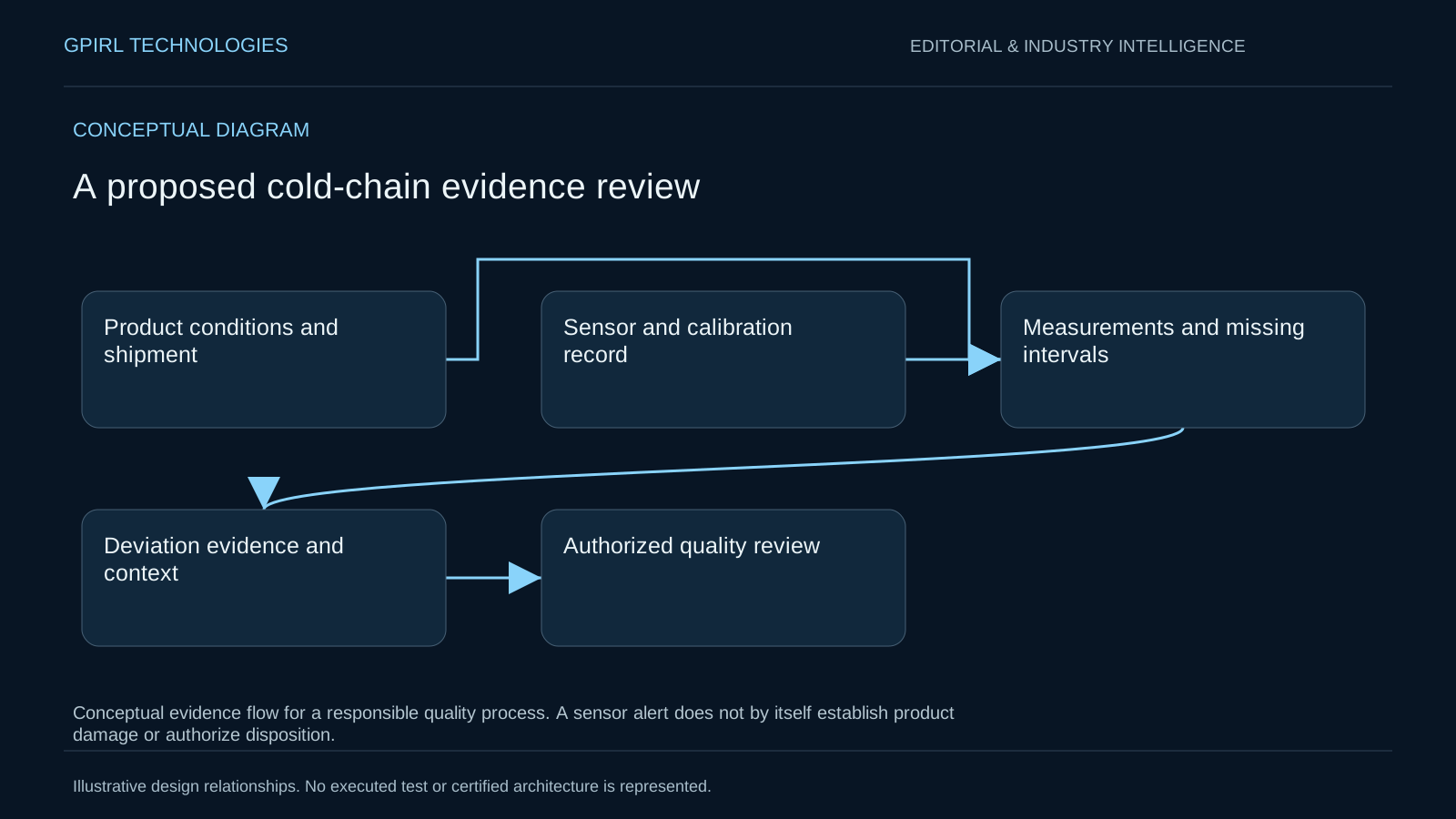
A proposed record review would identify the recorded interval, reported values, monitoring location, device identity and any missing observations before interpreting a temperature deviation. Calibration logs and related transport or packaging records could provide context where available; the reviewer would record their relevance and any unresolved mismatch. Neither retaining nor discarding a shipment is recommended by this article; those decisions require the applicable product-specific quality process. A complete account of available and missing evidence supports that process without substituting for it.
Synthetic Tabletop Cases in Cold-Chain Excursions
This proposed synthetic tabletop case has not been executed and reports no customer event or GPIRL product capability. It would use fictional records for a refrigerated-truck delay, including a logger gap and a later reading outside the fictional labelled range. Participants would identify what the sensor log records, locate its calibration evidence and list questions for the relevant quality unit, without calculating a release decision. The exercise would leave missing observations explicit rather than infer that conditions remained acceptable throughout the gap.
Tabletop case studies also examine how data recording failures, such as corrupted memory cards or battery depletion in transit loggers, affect the evidence available to a quality investigation. Teams analyze the evidentiary weight of secondary monitoring systems when primary sensors fail unexpectedly during international freight forwarding. The proposed output is an evidence-and-uncertainty log, not a finding that a batch remains suitable for use. No patient-safety outcome, product disposition or performance improvement is claimed for a scenario that has not been run.
Avoiding Unverified Claims and Legal Disclaimers
Maintaining professional credibility in pharmaceutical logistics requires avoiding unverified claims regarding universal firmware security, absolute sensor accuracy, or guaranteed regulatory approval. A performance or approval claim needs its own verifiable evidence; this article alleges no particular vendor conduct and reports no certification. A proposed source check would examine the actual calibration record, the stated measurement traceability and the scope of any validation evidence rather than a marketing slogan. The purpose is to make the basis and limits of a claim visible, without promising regulatory acceptance.
Furthermore, this analytical summary makes its limited purpose explicit, clarifying that published records support authorized internal review rather than providing formal legal advice. Regulatory compliance is an ongoing operational commitment that requires continuous vigilance, not a static certification achieved through software procurement. Transparent reporting can distinguish a recorded measurement from an interpretation and identify which authority or product evidence would be needed next. Neither a disclaimer nor a software purchase is evidence that a specific shipment met its required conditions.
Strategic Governance of Pharmaceutical Distribution
Effective strategic governance of pharmaceutical cold-chain operations demands continuous executive oversight, robust document control, and active cross-functional collaboration. As global distribution networks expand to deliver complex biological therapies and temperature-sensitive vaccines, maintaining environmental integrity becomes increasingly critical. One possible governance arrangement assigns owners for records, exceptions and review decisions, with responsibilities tied to the applicable quality system. Such an arrangement still needs evidence of actual implementation; its existence would not establish compliance or long-term operational resilience.
The future of pharmaceutical distribution relies on embracing data-driven risk management, advanced environmental monitoring technologies, and rigorous personnel training programs. By focusing on product-specific storage conditions, traceable calibration standards, and scientific excursion reviews, reviewers can make the evidence behind a cold-chain claim more inspectable. The narrower task discussed here is to preserve an attributable record of the observed conditions and the limits of those observations. Any product-quality or regulatory conclusion remains with the applicable authorized process, outside this research article.
Official background videos
External publisher context. These recordings do not demonstrate GPIRL products or validate the proposed designs.
- WHO: Controlled Temperature Chain (CTC) – Delivering vaccines more easily.
Official WHO background explains that controlled-temperature-chain approaches are product-specific and monitored. It reinforces why the article must not apply one universal storage range or infer a release decision from a sensor alert.
Sources and further reading
References do not imply product certification or endorsement.
Have a related operational question? Discuss an unresolved evidence question in your operating context with GPIRL Technologies.