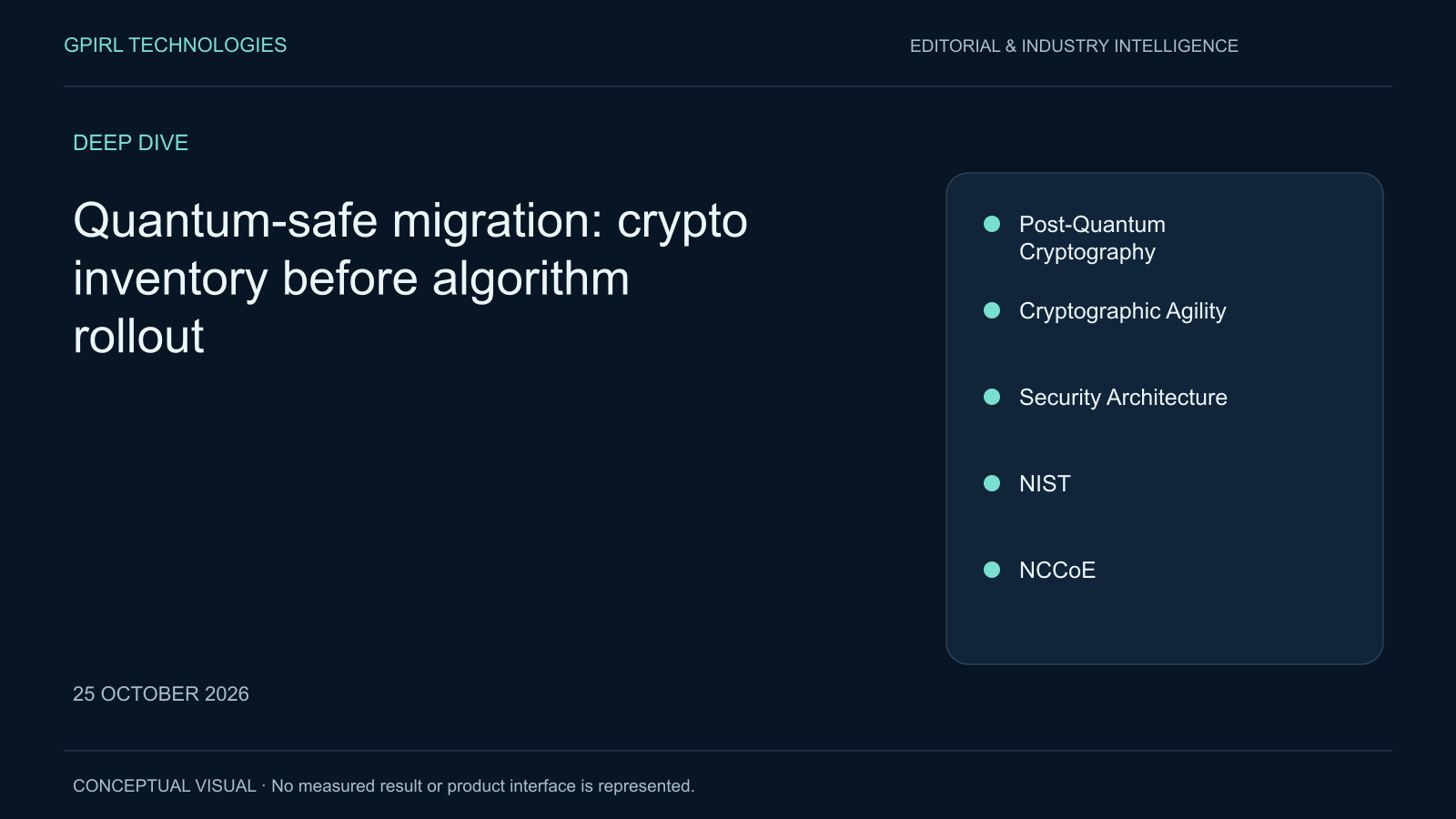
The Distinction Between Standard Publication and Deployment
Discussions surrounding post-quantum cryptography frequently encourage an aggressive race to substitute legacy algorithms with lattice-based or hash-based alternatives. However, treating cryptographic migration as a simple drop-in library replacement ignores the intricate web of dependencies embedded within modern software systems. Cryptographic primitives are rarely isolated functions; they are integrated into TLS handshakes, certificate authorities, database encryption layers, secure boot loaders, and proprietary messaging protocols. Attempting to deploy new post-quantum algorithms without a rigorous understanding of where and how legacy cryptography is utilized can introduce operational friction, performance overhead, or unexpected handshake failures.
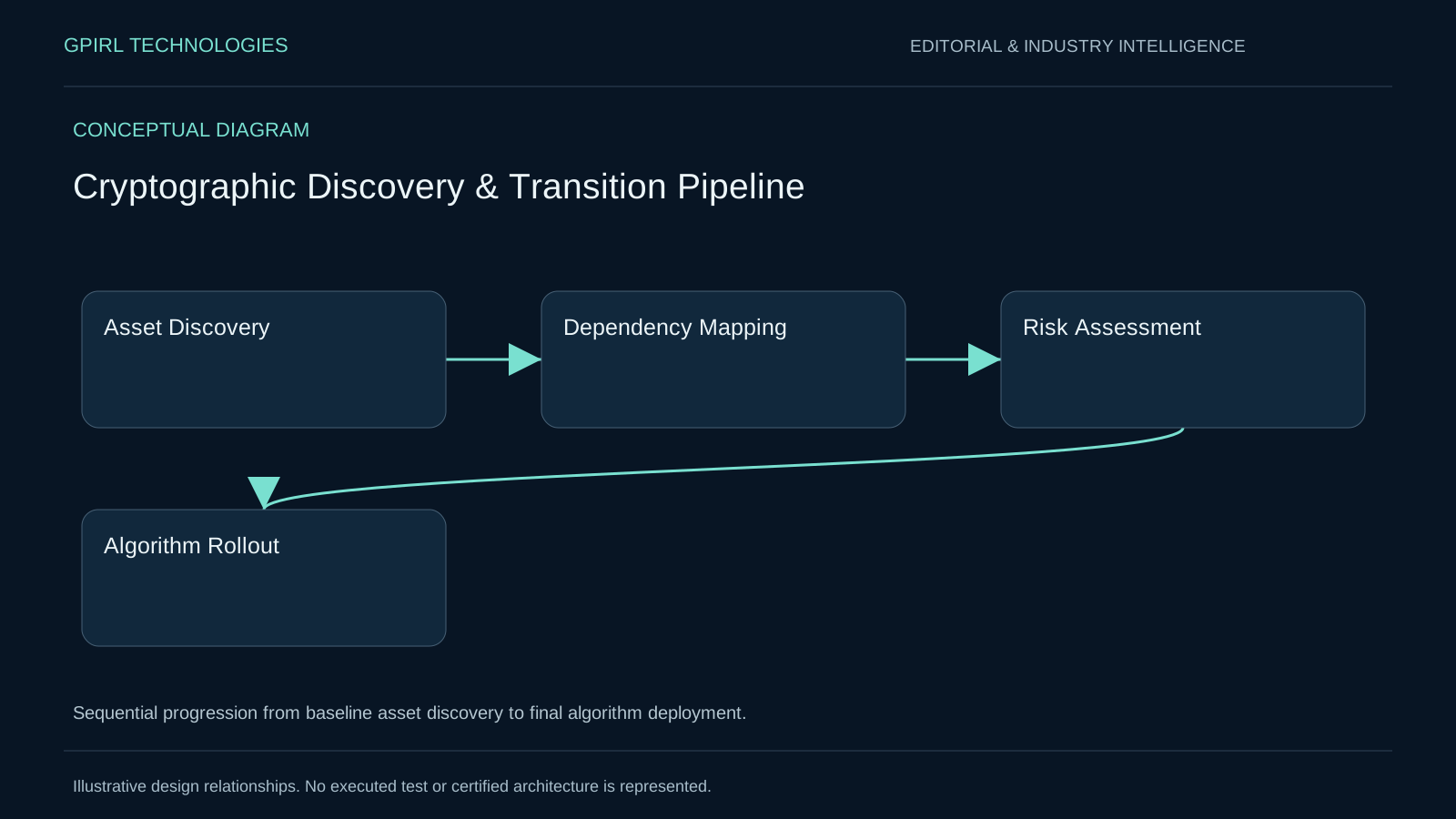
Furthermore, official standards established by bodies such as the National Institute of Standards and Technology (NIST) define algorithmic specifications rather than operational mandates or absolute security proofs. According to the NIST post-quantum cryptography project documentation, standardization marks the publication of mathematical specifications and parameter sets, not an automatic deadline or universal security guarantee for enterprise cutover [S1]. Organizations that conflate algorithm publication with immediate deployment requirements risk misallocating engineering resources. A disciplined migration strategy begins not with code deployment, but with comprehensive asset discovery and dependency enumeration.
Navigating this transition requires organizations to decouple algorithm evaluation from production implementation schedules. Standards define interfaces and parameter sets for primitives such as ML-KEM and SLH-DSA, but they cannot dictate how legacy applications handle expanded public key sizes or altered ciphertext lengths. Consequently, engineering teams can prioritize inventory completeness over haste, ensuring that software artifacts, container images, and hardware security modules are cataloged before algorithm rollouts are planned.
Establishing Cryptographic Inventories via Framework Guidance
An effective cryptographic inventory goes beyond a superficial scan of source code repositories or active TLS certificates. It requires tracing cryptographic usage across multiple tiers of the technology stack, including operating system kernels, runtime libraries, hardware security modules, third-party SDKs, and cloud services. NIST IR 8547 describes an expected transition approach for quantum-vulnerable key-establishment and signature standards [S2]. A local inventory may record algorithm, key size, certificate chain, protocol, owner and evidence gaps as proposed implementation fields; those details should not be misrepresented as a mandatory checklist from the draft. Because IR 8547 is a non-final draft published for public comment, its frameworks serve as consultative reference material rather than mandatory enterprise inventory standards.
To complement high-level transition guidance, specialized applied research initiatives offer practical implementation frameworks. The National Cybersecurity Center of Excellence (NCCoE) migration to post-quantum cryptography project provides guidance on discovering and testing cryptographic assets across hardware, software, and cloud services [S3]. Its published workstreams distinguish cryptographic discovery from interoperability testing [S3]. A local team can compare repository/configuration inspection, protocol observations and vendor evidence as complementary discovery methods, recording which dependencies each method cannot see.
Maintaining an up-to-date inventory remains an ongoing operational challenge rather than a one-time project. As development teams adopt new frameworks, container images, and cloud services, cryptographic surface areas shift continuously. Establishing automated inventory pipelines that integrate into CI/CD build processes can help teams catalog newly introduced dependencies, transforming cryptography from an opaque administrative burden into a visible, governable component of software architecture.
Mapping Data Lifetimes and Decryption Horizons
A critical dimension of cryptographic inventory work involves analyzing data lifetimes alongside algorithm selections. Threat actors can intercept and store encrypted network traffic with the intention of decrypting it once cryptographically relevant quantum computers become operational—a strategy commonly referred to as store-now-decrypt-later. Consequently, data with long confidentiality horizons, such as intellectual property, long-term healthcare records, and classified communications, faces potential risk if current encryption standards are eventually broken by future systems.
Mapping data lifetimes requires categorizing datasets by regulatory sensitivity, business value, and required retention periods. If a dataset must remain confidential for decades, and quantum systems capable of breaking public-key mechanisms such as RSA or elliptic-curve key establishment are anticipated within a future timeframe, that data's long-term confidentiality window intersects with cryptographic evolution timelines. Inventory processes can link specific cryptographic keys and algorithms directly to the data stores they protect, enabling security teams to prioritize migration efforts based on actual exposure timelines.
Balancing data lifetime requirements with migration velocity requires pragmatic compromise. An archive review should distinguish bulk encryption, key wrapping, key establishment and signatures. A PQC transition does not by itself mean that every stored dataset needs a new bulk cipher. The proposed priority record should explain confidentiality lifetime, dependency exposure and migration constraints rather than automatically classifying all archives ahead of every short-lived service.
Protocol Handshakes, Key Establishment, and Symmetric Encryption
A useful inventory distinguishes public-key key establishment and signatures from symmetric bulk encryption. The cited NIST transition project addresses standardized key-establishment and signature schemes [S1]. An engineering review should record each mechanism's role before choosing a response. It should not infer a universal AES key-length migration rule, or a promise of permanent security, from the label 'post-quantum'. Changes to protocol negotiation, certificate validation and stored-data protection are separate decisions with separate evidence needs.
Cryptographic protocols rely on complex handshakes and hierarchical certificate chains that are sensitive to changes in key sizes and signature formats. The selected algorithm can change public-key, signature or encapsulation-message sizes; the relevant comparison depends on the cryptographic role and implementation. When integrated into network protocols like TLS 1.3 or SSH, these expanded payloads can exceed maximum transmission unit (MTU) sizes, triggering packet fragmentation, increased handshake latency, or connection failures in constrained network environments.
Furthermore, hardware security modules (HSMs) and trusted platform modules (TPMs) deployed across datacenters may have hardware or firmware constraints on supported algorithms. Inventory workflows can catalog hardware capabilities supporting each protocol endpoint to determine whether existing silicon can be updated via firmware or requires physical replacement. This co-dependency analysis helps prevent teams from deploying software-level post-quantum upgrades that bottleneck on legacy physical processors.
Hypothetical Tabletop Scenario: Mapping Endpoints and Owners
To evaluate readiness without asserting guaranteed outcomes, consider a hypothetical tabletop exercise conducted by an enterprise architecture team. The organization designs a tabletop simulation to map cryptographic dependencies across a representative sample of internal microservices and external payment gateways. Rather than assuming a successful company-wide rollout, the exercise focuses on identifying ownership gaps, undocumented certificate stores, and evidence gaps in current software documentation.
During the tabletop simulation, participants review a subset of service endpoints and discover that several internal applications rely on legacy TLS profiles with hardcoded cipher suites. The exercise does not execute production changes; instead, it tests non-production interoperability by evaluating vendor-supported candidate protocol implementations in a staging environment to observe packet fragmentation limits and handshake latency under simulated load.
The primary value of this hypothetical tabletop exercise lies in what it reveals about organizational visibility. By documenting where ownership is unclear and where automated inventory tools fail to scan proprietary libraries, the architecture team constructs a realistic baseline for future migration planning, avoiding unrealistic assumptions about instantaneous inventory completeness.
Evaluating Vendor Debt and Third-Party Dependencies
Enterprise software ecosystems depend heavily on third-party vendors, open-source libraries, and SaaS platforms. Consequently, an organization's cryptographic posture is influenced by vendor integrations. Cryptographic debt accumulates when vendors rely on deprecated algorithms, outdated cryptographic wrappers, or closed-source modules that cannot be inspected independently. Inventory processes can extend beyond internal codebases to encompass third-party risk assessments and vendor software composition analyses.
Evaluating third-party cryptographic debt requires establishing clear contractual expectations regarding cryptographic agility and post-quantum readiness timelines. Vendors can be queried about their internal migration roadmaps, support for hybrid certificate modes, and compliance with emerging standards. However, relying solely on vendor self-assessments is insufficient; engineering teams can independently verify third-party libraries within staging environments using binary analysis and protocol inspection tools.
Addressing vendor cryptographic debt often necessitates procurement and architectural decisions. If a critical enterprise vendor refuses to commit to post-quantum migration within a realistic window, the organization evaluates alternative suppliers, encapsulates the legacy vendor behind secure API gateways with translation layers, or accepts residual risk with documented executive sign-off. Inventory data provides the empirical foundation required to inform vendor discussions.
Designing Cryptographic Agility Frameworks
The goal of pre-migration inventory work is the realization of cryptographic agility—the architectural capability to update cryptographic algorithms, keys, and protocols without requiring massive application rewrites or service downtime. Cryptographic agility can be approached by abstracting cryptographic operations behind internal interfaces or service wrappers, ensuring that applications invoke high-level security functions rather than hardcoding specific cipher implementations.
Designing for agility involves standardizing configuration management across software tiers. Cryptographic parameters can be dynamically injectable via secure configuration stores rather than compiled directly into binary artifacts. This allows security operations teams to rotate algorithms, adjust key rotation frequencies, and enable hybrid modes across participating services. Agility frameworks can also simplify rollback procedures should a newly deployed post-quantum algorithm exhibit unforeseen performance bottlenecks.
While achieving total cryptographic agility requires upfront engineering investment, it can insulate the enterprise from future cryptographic disruptions. Whether responding to a newly discovered vulnerability in an established lattice-based scheme or adapting to shifting regulatory guidance, agile architectures enable structured adaptation.
Decision Checklist for Inventory-First Migration
To ensure a structured approach to post-quantum migration preparation, engineering and security leadership can utilize a decision checklist:
1. Asset Discovery Scope: Have core software repositories, container images, and network endpoints been cataloged for cryptographic primitives?
2. Data Lifetime Classification: Are high-confidentiality datasets mapped to their respective encryption keys and retention horizons?
3. Dependency Mapping: Are TLS handshakes, certificate authority chains, and protocol payload size limitations documented for critical services?
4. Third-Party Audit: Have external vendors and open-source dependencies been evaluated for cryptographic agility roadmaps?
5. Abstraction Review: Are cryptographic functions decoupled from business logic via internal APIs where feasible?
6. Non-Production Testing: Have hybrid cryptographic modes been evaluated for network fragmentation and latency impact in staging environments?
Limitations, Edge Cases, and Misconceptions
It is essential to acknowledge the inherent limitations of cryptographic inventory and migration frameworks. No discovery tool is infallible; deeply obfuscated code, custom cryptographic implementations written in assembly, and legacy firmware routines can evade automated scanners. Furthermore, achieving complete cryptographic agility across a legacy enterprise estate can be economically challenging, requiring organizations to accept calculated residual risks for peripheral systems.
Another common misconception is that NIST standards and federal migration guidelines provide a universal legal compliance shield. In practice, standards outline technical parameters and evaluation criteria, not liability frameworks or absolute guarantees against sophisticated adversaries. Editorial proposals and architectural frameworks are designed to guide engineering decisions, but they must be adapted to the specific risk appetite and regulatory context of each enterprise.
Finally, organizations can guard against analysis paralysis. While inventory completeness is important, spending years cataloging every minor cryptographic dependency without initiating phased testing in non-production environments can leave an enterprise unprepared. A balanced approach combines rigorous initial inventory discovery with iterative experimentation using standardized cryptographic libraries.
Official background videos
External publisher context. These recordings do not demonstrate GPIRL products or validate the proposed designs.
- Post-Quantum Cryptography: the Good, the Bad, and the Powerful
Official NIST background published in 2021, before the 2024 final standards. Historical threat context; does not establish current algorithm status, a universal deadline or any capability.
Sources and further reading
- [S1] NIST Post-Quantum Cryptography Project
- [S2] NIST IR 8547 (Initial Public Draft) - Transition to Post-Quantum Cryptography
- [S3] NCCoE Migration to Post-Quantum Cryptography Project
References do not imply product certification or endorsement.
Have a related operational question? If your organization is evaluating cryptographic inventory frameworks for upcoming migration cycles, let's discuss your roadmap.