Introduction to Digital Business Reporting Standards
Digital business reporting has influenced regulatory compliance, corporate transparency, and financial analytics across global markets. At the core of this framework is XBRL (eXtensible Business Reporting Language), an open standard designed for the electronic communication of business and financial data. According to key concepts and taxonomy guidance from XBRL International, the standard structures business reports into machine-readable data items, enabling automated validation and comparative analysis [S1].
However, treating XBRL as a superficial tagging exercise can lead to analytical misinterpretation. Financial reporting data is multidimensional, capturing numerical values alongside precise definitions, reporting periods, measurement units, and entity identifiers. When analysts or automated pipelines extract XBRL instances without understanding the underlying technical architecture, they can misinterpret reported facts.
Navigating XBRL data structures requires examining taxonomies, instance documents, and contexts. According to the XBRL essentials and reporting requirements guidance, an XBRL instance combines reported facts with contextual metadata defining when, how, and by whom each metric was measured [S2, S3]. This data brief examines core components of XBRL architecture, highlighting why matching labels does not guarantee comparable financial facts.
Taxonomy Architecture and Concept Attributes
An XBRL taxonomy serves as a dictionary defining specific financial reporting concepts, hierarchical relationships, and data types. Taxonomies like US GAAP or IFRS establish concepts such as assets, revenues, or net income. Concepts are identified by qualified names and defined with types and applicable attributes; they may have multiple labels [S1].
Crucially, the existence of a standard taxonomy concept does not imply that reporting entities use it identically. Corporations can create custom taxonomy extensions or select different concepts to represent economic activities. For instance, two companies might report revenue figures using distinct concept identifiers based on their industry classification or accounting policies. Automated ingestion tools relying solely on textual label matching rather than formal taxonomy concept references can produce non-comparable datasets.
Furthermore, taxonomy structures include definition, calculation, and presentation linkbases that govern concept relationships. Presentation relationships organize concepts for display, while label linkbases associate human-readable text with concepts [S1]. Understanding these hierarchical links assists in validating that reported sub-totals reconcile with aggregate financial statement totals.
Contexts: Entity Identification and Reporting Periods
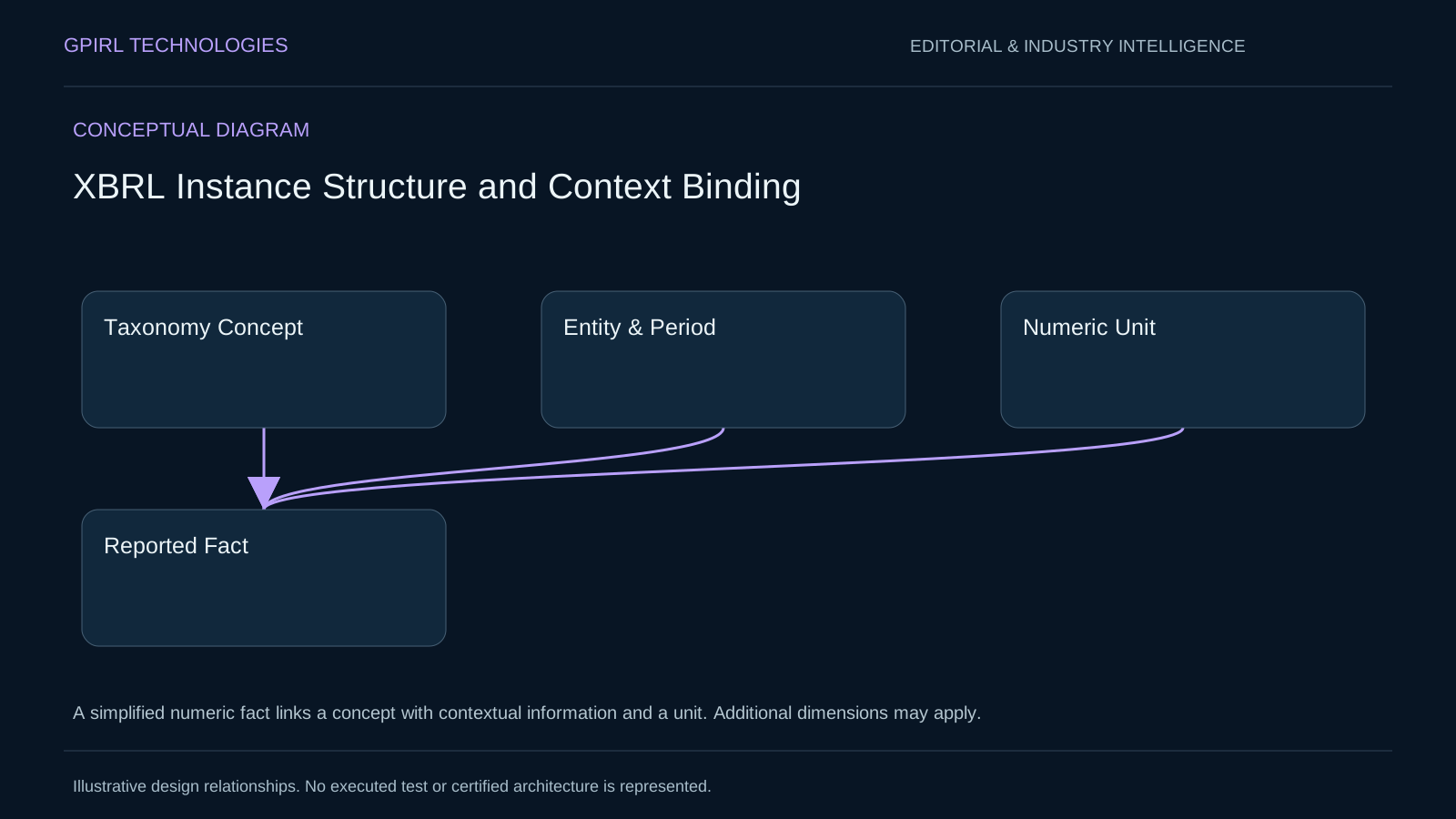
In XBRL architecture, a reported fact is interpreted through its associated context. The official essentials overview distinguishes facts, concepts and contextual information. A context identifies the entity and period, with additional qualifying information as applicable; numeric units are a separate part of the fact representation [S2]. The recommendation index links to the underlying specification rather than itself defining every rule [S4]. Two numeric values representing revenue may share the same taxonomy concept, but if their contexts differ—such as one representing a three-month fiscal quarter and the other a twelve-month fiscal year—they are not directly comparable.
Temporal contexts in XBRL support instant, duration, and forever types. Instant contexts represent balances at a point in time, such as cash on hand as of the final day of a fiscal quarter. Duration contexts represent flows occurring over a time interval, such as cash flow generated during a six-month period. Conflating instant and duration contexts during data aggregation leads to arithmetic errors in financial analytics pipelines.
Moreover, dimensional contexts allow companies to disaggregate financial metrics by product line or geographic region. Analyzing these dimensional slices requires parsing explicit context member definitions within XBRL instances. Financial data engineers build validation logic verifying context compatibility before cross-company financial comparisons.
Units of Measure and Dimensional Qualifiers
In addition to entity and period contexts, every numerical fact in an XBRL instance is associated with a unit of measure. XBRL supports standard currency units, pure numbers, ratios, shares, and divided measures such as currency per share. The unit definition element ensures that monetary amounts are interpreted correctly when aggregating data across operations.
Dimensional qualifiers refine how facts are categorized. XBRL dimensional reporting allows filers to attach axes and members to standard taxonomy concepts, enabling multi-dimensional reporting without requiring an explosion of unique taxonomy concepts. For instance, a basic property concept can be qualified using a class-of-property axis to report land, buildings, and equipment separately within an instance document.
Failure to account for unit definitions and dimensional qualifiers during data extraction results in reporting anomalies. Unit conversion does not make a monetary amount and a dimensionless ratio additive. A review should first establish that the quantities, scope and periods are comparable before selecting any valid normalization [S3].
Hypothetical Fact Comparison Without Company Datasets
To illustrate how XBRL context and unit differences affect data interpretation without inventing company accounts or financial datasets, consider a hypothetical comparison of two abstract reporting facts sharing the same taxonomy concept for research and development expense.
Fact A reports an R&D expense value with a duration context spanning the fiscal year ended December 31, 2025, expressed in USD currency units. Fact B reports an R&D expense value with a duration context spanning a three-month fiscal quarter ended March 31, 2026, expressed in EUR currency units, with an additional dimensional qualifier for a specific operating segment. A naive data extraction pipeline that matches only the taxonomy concept QName and aggregates both numbers will produce a mathematically invalid sum due to differing temporal periods, currencies, and dimensional scopes.
This hypothetical comparison illustrates why financial data pipelines evaluate concept QNames, temporal contexts, unit definitions, and dimensional attributes together rather than treating XBRL facts as uniform numbers.
Why Label Matching Does Not Equal Comparable Facts
A pitfall among analysts is relying on string-based label matching to compare financial data across companies. Because XBRL allows human-readable labels to be customized or overridden within label linkbases, two companies reporting different financial metrics can display similar text labels in rendered viewers.
Technical comparison should check concept identity, entity, period, unit and any relevant dimensions. Economic comparability still requires reviewing definitions and accounting context; matching those attributes is not a guarantee. An analyst searching for operating income by matching text strings can capture non-comparable operating metrics or non-recurring items that distort financial models.
Building reliable financial data pipelines requires extracting structured fact items via formal taxonomy QNames and parsing contextual attributes. Structured extraction makes the reported attributes reviewable; it does not by itself establish economic equivalence across accounting policies or reporting entities.
Taxonomy Extensions and Validation Boundaries
While standard taxonomies provide a baseline, reporting frameworks permit entities to create custom taxonomy extensions when standard concepts do not adequately capture unique business operations. However, excessive extension concepts can complicate standardized comparability.
When companies create custom extension concepts for financial metrics, automated comparison tools navigate extension relationship linkbases. Data quality assurance teams audit extension taxonomies to verify that custom concepts are structured appropriately.
Furthermore, automated validation engines play a role in catching syntax and logical errors in XBRL filings before submission. However, validation tools verify technical specification compliance and formula consistency; they do not determine whether a company selected the correct accounting concept for a complex transaction. Business assurance and domain expertise remain useful.
Data Brief Decision Checklist for Financial Analysts
To ensure structured extraction and analysis of XBRL financial filings, analysts and data engineers can utilize a decision checklist:
1. Concept QName Verification: Are facts extracted using formal taxonomy QNames rather than text labels?
2. Context Period Matching: Are temporal contexts verified to distinguish between instant balances and duration flows?
3. Unit Normalization: Are monetary and numeric units validated and normalized before cross-company comparison?
4. Entity and Dimensional Alignment: Are entity identifiers and dimensional qualifiers parsed to isolate business segments?
5. Extension Review: Have custom extension concepts been checked for appropriate structuring?
6. Validation Review: Have technical validation reports and formula consistency checks been reviewed prior to analysis?
Technical Limitations and Assurance Boundaries
It is essential to recognize the technical limitations and assurance boundaries inherent in XBRL reporting systems. XBRL ensures structured data formatting, syntactic validity, and machine-readable consistency, but it does not provide absolute proof of underlying accounting accuracy or legal compliance. Editorial proposals and technical briefs are designed to guide data engineering practices, but they are interpreted in conjunction with professional financial auditing standards.
Furthermore, XBRL instance documents can become large, consuming computational resources during parsing and aggregation. Modern data pipelines convert XBRL instances into columnar or relational formats for analytical querying, requiring careful mapping of context tables to maintain data integrity.
Ultimately, digital financial reporting requires a synthesis of accounting expertise, XBRL architectural knowledge, and data engineering. By mastering taxonomy concepts, context bindings, and unit definitions, organizations can work with structured business reporting.
Official background videos
External publisher context. These recordings do not demonstrate GPIRL products or validate the proposed designs.
- What is XBRL?
Official standards-body introduction to digital business reporting; general context, not a guarantee of factual or economic comparability.
Sources and further reading
- [S1] XBRL International - Key Concepts in XBRL: Taxonomies
- [S2] XBRL Essentials
- [S3] XBRL Reporting Requirements
- [S4] XBRL 2.1 Specification Work Product Index
References do not imply product certification or endorsement.
Have a related operational question? If your organization is navigating complex structured financial reporting data pipelines, let's discuss your architecture.