A detailed model can still answer the wrong question
A manufacturing digital twin is often discussed in terms of how closely it resembles an asset. That invites a race toward more detail: additional geometry, more measurements and increasingly frequent updates. A more useful starting point is the decision the model is intended to support. What alternatives will somebody compare, which errors would change that choice, and what evidence would justify trusting the comparison? Detail matters when it changes the answer to those questions.
This explainer proposes a purpose-led way to reason about fidelity. It does not report a completed simulation or advise operating a machine from a model output. The central argument is conditional: a representation should be detailed enough for its stated decision and its uncertainty should remain visible. A low-detail model is not automatically adequate for strategic planning, and a high-detail model is not automatically suitable for maintenance. Either conclusion needs evidence about the intended use.
Credibility is broader than resemblance
NIST's manufacturing digital-twin publication considers credibility in relation to intended purpose and discusses verification, validation and uncertainty quantification, alongside factors beyond those activities [S1]. That establishes a useful distinction between a model's appearance and the support for using it. It does not supply a universal fidelity threshold or certify the suitability of a particular twin. The relevant purpose still has to be stated by the people evaluating the application.
W3C's Data Quality Vocabulary provides ways to describe quality measurements and annotations. It is a Working Group Note rather than a universal quality score or an instruction to use one fixed definition of quality [S2]. Applied here as an editorial interpretation, this encourages documenting what a measure means and why it matters. A model can have many quality indicators without a clear account of whether those indicators address the decision under review.
Write the decision before selecting the representation
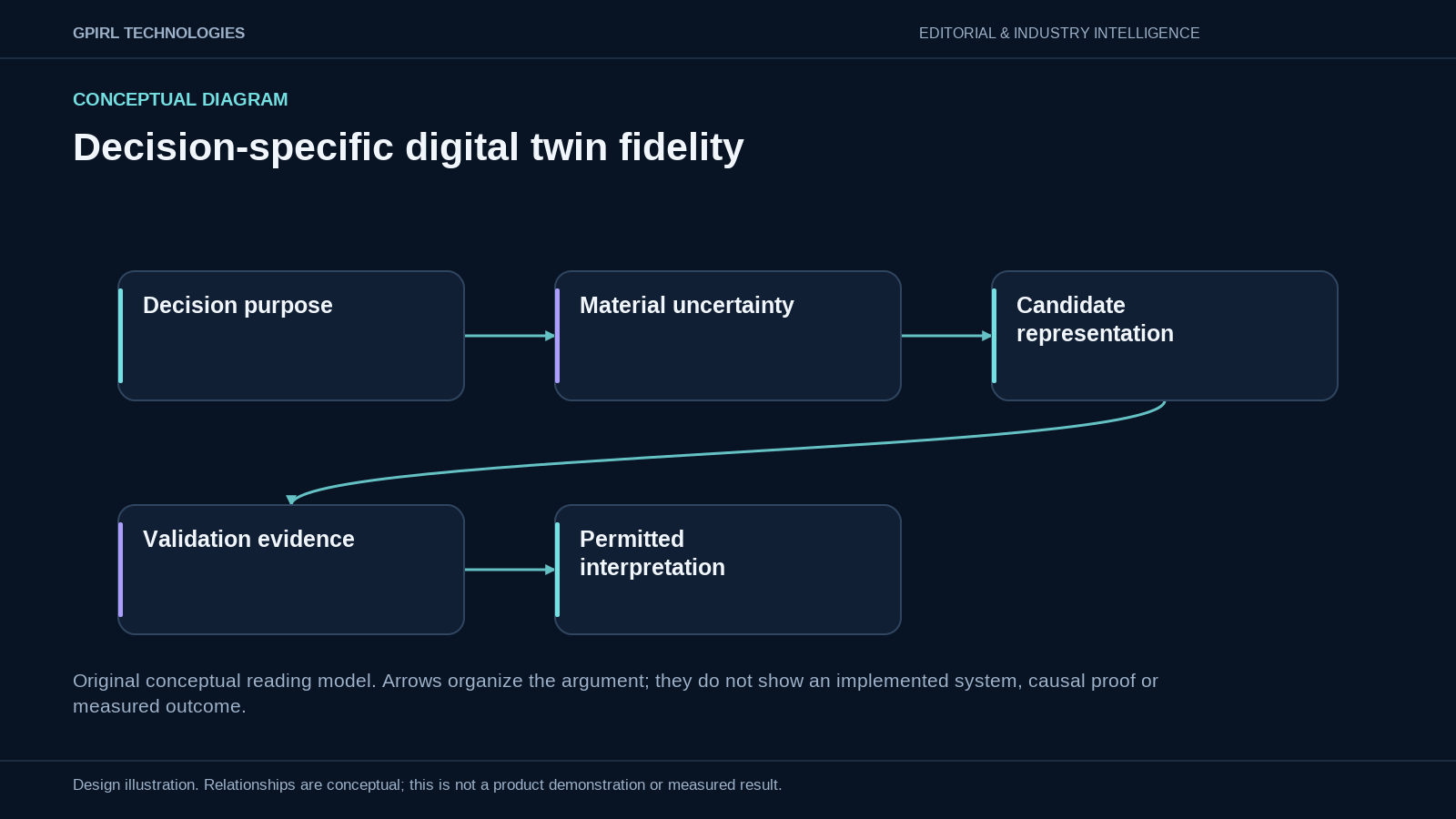
A proposed decision statement might say: compare two candidate production schedules under a stated demand assumption, with attention to a named capacity constraint. That is already more informative than asking for an accurate factory twin. It identifies alternatives, an assumption and a concern. The next question is what information could reverse the comparison. If the constraint depends on an uncertain changeover duration, refining an unrelated visual detail would not directly address that uncertainty.
This is a conceptual example, not a finding about any factory. The decision statement would need to specify the time horizon, acceptable consequences of error and who is responsible for acting. It should also identify decisions outside the model's scope. A schedule comparison does not thereby support equipment diagnosis, worker assessment or safety-critical control. Keeping those purposes separate allows reviewers to ask for additional evidence when a model is proposed for a new use.
Compare candidate fidelities without inventing results
Consider three proposed representations of the same imagined process: a capacity calculation, a discrete sequence model and a more detailed physical representation. These are alternatives for discussion, not models built or tested for this article. A comparison would ask what each represents, what it omits and which assumptions dominate its outputs. The simpler alternative could be rejected if an omission changes the decision. The more detailed alternative could be rejected if its additional parameters cannot be justified.
No time savings, prediction accuracy or financial return is assigned to these alternatives. Such numbers would require a specified dataset, an implemented method and a defensible comparison. The useful output of this conceptual exercise is a list of differences that require evidence. It might reveal that the decision depends more on a missing operating regime than on a finer numerical step. It might instead reveal that a coarse assumption is unacceptable. Both remain possibilities until evaluated.
Separate model checks from evidence about the process
In a proposed review, checking that a model implements its stated equations or rules is different from checking whether those equations or rules adequately represent the relevant process. A program can reproduce its specification and still misrepresent the factory. Conversely, a plausible comparison with one observed period may conceal a coding defect or an unexamined condition. The review should name what each piece of evidence addresses, with verification and validation claims kept appropriately bounded.
Uncertainty deserves the same precision. Identify uncertain inputs, uncertain relationships and missing conditions rather than placing them all under a generic confidence label. A sensitivity analysis could help explore how assumptions affect a comparison, but this article has not executed one. Nor does such an analysis eliminate uncertainty by itself. Its value would depend on the range examined, the model's scope and whether the important sources of uncertainty were included.
Data freshness is part of a purpose
A representation updated every second is not necessarily more useful than one updated less frequently. In this proposed framework, the required update behavior follows from the decision horizon and the consequences of stale information. A planning discussion might tolerate some delayed inputs and reject others. A maintenance interpretation might depend on event context rather than update frequency alone. These are questions for the actual application; no universal refresh interval is implied.
The data-quality description should identify the measurement, its time meaning, available coverage and any transformations applied before it enters the model. An annotation can make a missing value visible, but it cannot recover the physical event that was never observed. Likewise, a quality score is not a substitute for deciding whether an absence matters. A reviewer needs the connection between a data limitation and the decision the twin is expected to inform.
Record why detail was excluded
A purpose statement also benefits from an explicit account of exclusions. In the conceptual schedule comparison, the team might decide that a particular physical effect is outside the representation. It should state why that exclusion is believed acceptable and what observation would challenge the assumption. Otherwise an omission can disappear from institutional memory and be mistaken for a validated simplification. This record does not make the simplification correct. It makes the reasoning reviewable, allows a later user to recognize a changed condition and helps prevent a narrowly justified model from quietly acquiring a broader purpose.
Fidelity should have a revision trigger
A proposed model agreement should identify changes that would require reassessment. A changed product mix, altered equipment behavior or a new decision purpose might invalidate earlier assumptions. This is an editorial suggestion about managing model use, not a claim that NIST prescribes a particular agreement. The trigger should be understandable to those who notice the change, so that the model does not continue to inherit credibility from an earlier, narrower context.
The final question is whether the added detail earns its place. It should address a decision-relevant limitation, come with support for its parameters and remain feasible to maintain. The answer may be to add detail, improve evidence or reduce the scope of the promised use. A credible digital-twin discussion can end with an unanswered question. What matters is that the unresolved issue is visible before a model comparison becomes an operating commitment.
Official background videos
External publisher context. These recordings do not demonstrate GPIRL products or validate the proposed designs.
- International Telecommunication Union (ITU) — Ask the Expert Session: Connecting physical and virtual worlds with digital twins
ITU discussion connects physical and virtual worlds through digital-twin standards; manufacturing decision fidelity still requires separate validation.
Sources and further reading
References do not imply product certification or endorsement.
Have a related operational question? Explore this question with GPIRL Technologies.